


Horror Stories of 1,000 Words or Less
For the month of March 2026, these are
the stories that entertain us most.
* Vampire Sighting? On Pecan Park?? by J.S. Spencer
* Reabsorption by Karly Foland
* The World Tree Awakens by Aza Smith
* Protein by Rick McQuiston
* Four Eyes by Mike Bown
* New Tenants by Alice Yustas
* The Trafficker by T.W. Gill
* Mother of the Night by Justine Rummage
* Abraham's Chain by Mark Henricks
* Offal by Allison Westphal
* Now I Am Six by Lisa Baker
* My Sister Elsbeth by Antoinette Bekker
* The Dead of Winter by AJ Atwater
* A Walk in the Woods by Cynthia Pitman
* Vengeance by M. Conant-Carr
* Stillness by Ria Cabral
* Another Slice by Jane Ayres
* Miles McKewan's Final Moments by Carson Fredriksen
* Next of Kin by Shannon Scott
* Cooler #5 by Ian Patt
* Dogs for Cassie by C. Kohrs
Vampire Sighting? On Pecan Park?? by J.S. Spencer

“Shhh!”
Jeffrey Herbert whirled around with his JVC digital camera in hand. “What, you heard something?”
Craig Hilt raised a finger to listen. No use. He dropped it back down with a sigh and shook his head. “God damnit, it’s gone now, the son of a bitch! You keep talking! I swear, I did not come out here just to go back to Bill and look stupid. We are finding this vampire tonight!”
Craig was right: they didn’t come all the way out to these woods just to return to the boss with nothing. The clearing they were in, with the endless longleafs encircling them, and the full moon obscured by occasional clouds—all of it had an eerie stillness, although the wind drove some branches rustling. Yes: of course, terror leaped into Jeffrey’s heart, prompting the sweat on his skin to turn cold—but he was prepared and thrilled all the same. They would find this vampire.
As if to confirm it, a wolf howled.
Jeffrey Herbert and Craig Hilt, two directors of the Nighttime Horrors Program, a low-budget TV series that only aired at night, had gone to the boss one night ago, reporting a woman’s call-in of a vampire sighting on Pecan Park Road. “This can get us lots of views, boss,” Craig had said animatedly. “Vampires are all dudes talk about lately, with Twilight and shit coming out.”
“No,” William Kensington had said. “We’re doing real horrors here, not supernatural vampire bogus.”
“Oh, what kinda shit is that, boss?”
“You heard me.”
After a long stare-off, Jeffrey had finally broken the tension. He threw last month’s paycheck onto Bill’s desk and leaned over it. “Fine. We’ll go out there and get the footage ourselves. If not? You fire us. If? You authorize the episode.”
Boss Kensington had smirked—wickedly: a real wicked smirk. Jeffrey and Craig had always gotten the feeling Bill had something against them.
“All right,” he’d said at last. “But you two better be careful. I’ve got a feeling this is going to be too much fun.”
And for no reason at all, he smirked wickedly again.
A branch cracked nearby, snapping Jeffrey out of this memory, and was then replaced by a distant flapping. He listened. A bird was using its wings—forcefully, it seemed—and getting rapidly closer. But he couldn’t see it anywhere nearby.
Suddenly, Jeffrey heard Craig's hysterical shout to his left and swung his camera in that direction. His friend was being carried away into the sky by an unnaturally pale figure with black wings and gleaming red eyes. Craig’s screams died away in the night. A moment later, he was gone.
Then Jeff’s camera swung in front of him, and from behind the towering trees caught six of them piling out, all side-by-side. They looked hideous—and ghastly pale. All female. Piss started to stream down Jeffrey’s leg.
He turned and ran. Branches clawed his face, the monsters who’d poured out pursued; he could hear their rapid footsteps gaining on him. Four more overhead appeared, and Jeffrey had to dodge at every downward swoop they made that would’ve picked him off the ground like Craig. Oddly enough, he was laughing. The vampires were real! He’d gotten the footage, and they were real! What would Bill make of this?
He broke free of the woods and came to the two-way road where they had parked the car, and that was when all the laughter zipped out of him as fast as lightning. He became motionless. The boss was sitting on the hood of the Honda, smoking a cigarette, as if he had been waiting for him.
“Ah! Jeffrey, my boy! I thought I’d find you out here.”
From a trembling hand, Jeffrey dropped his camera.
The boss stepped in front of him and placed a welcoming hand on his shoulder; the hand felt inhumanly plastic and cold. One question was all it took for Jeffrey’s puzzlement to turn into a click.
“Jeffrey, my boy ... you ever wonder why we only run the show at night?”
“Oh no ...” Jeffrey realized. “No! No!”
“Shhh. Now, now, it’ll all be over soon.”
The boss’s smirk split wider into a nightshade grin, revealing canine teeth grown hideously long and sharp. He stepped back and whistled to the woods. Dimly, Jeffrey could see the others circling around him, and at last he accepted it. He dropped to his knees, cried out—
—and the fallen JVC camera caught the rest.
J.S. Spencer is an upcoming author from Jacksonville, Florida. He mostly writes horror, science fiction, and thrillers, but occasionally drifts off to coming-of-age stories as well. He has received an honorable mention in the Writers of the Future Contest, has placed third in a horror contest at the Florida State College at Jacksonville, will have a horror short story published in the Shlock! Webzine for their November 2026 edition, and enjoys spending most of his time with his family.
Reabsorption by Karly Foland

Rap rap KNOCK rap.
The woman shifted her weight as she tucked her cashmere scarf tighter around her throat. Little puffs of breath materialized every two seconds from the stroller in front of her.
The small metal window cover slid open. Skeptical, bloodshot eyes surveyed the alley, then met hers. “Well?”
“I'd like a ticket to the Arctic,” then, when nothing happened, “Please.”
The cover slid shut, and the door cracked open. The eyes, deep set in the haggard face of a middle-aged woman in tattered, mismatched green and purple scrubs, glanced down. “It's a lengthy procedure, and we have no babysitters.”
“That won't be necessary,” the woman forced the stroller in, eliciting a quiet yelp when a tiny foot rammed into the door jamb. She waited for the door to shut and lock before continuing and nodding downward. “This'll be the subject of the reabsorption.”
The doctor's eyes widened, then narrowed, “You're misinformed. Reabsorption is for fetuses, not...”
“She might as well be one,” the woman interrupted. “She clings to me nonstop. Still breastfeeds despite all attempts at weaning. She's sucking every bit of my life force. I can't live like this. I need her to give me strength for once, not take it.”
The doctor stared at the woman, then down at the yawning baby, likely still under one year old. This would be illegal and unethical, but so was fetal reabsorption, so this carried the same risk, but with a greater payoff. “Fine. But it'll cost you. Upfront.”
The woman pulled a thick stack of bills from her black leather purse and held it out. The doctor crossed her arms and scoffed. The woman took out another, sighed, then emptied the entire contents onto the floor. The pair of diamond studs she forgot she had removed a block into her walk through this neighborhood skittered across the floor.
The doctor smirked. “Just think of how much you'll save in the long run,” her eyes flicked to the child and back. “Do you have a cover story for her disappearance?”
“Of course, I've thought of everything. Now let's get on with it.” The woman tossed her coat and gloves aside and moved toward the operating table. “Oh, be careful, will you? That head of hers gave me three stitches on the way out. I'd prefer not to repeat that on the way back in.”
Karly Foland is a writer of speculative fiction from Omaha, NE, USA, who has spent over a decade living in Africa, Asia, and Europe. She lives with her husband, daughter, and the two cats they rescued from the streets of Rabat. Her writing and photography have appeared in print and online and can be found on karlyfoland.com.
The World Tree Awakens by Aza Smith

Earth’s surface cleaves open.
Hand-like branches reach upward past the stratosphere. Roots dig through the mantle, perhaps further. Tectonic plates displace, tsunamis crash, cities collapse, calderas erupt, power plants melt down, and dust rides the wind.
The World Tree awakens.
The countless fingers of its centimanes grasp into fists, pointing in judgment in every direction. And from there, a signal bombards the planet.
A call to the wild that the law shall be passed.
The law of the jungle.
In a no-kill dog pound in Seattle, the dogs all break free. Once tame and docile, their caretakers are torn to pieces and fed to the pack as meat. For a moment, a Scottish Terrier looks at Kathy, a caretaker who considered adopting him, with consideration. But his will is subsumed by the wolf within, and blood floods her lungs with her throat in his teeth.
A sea of trees grows overnight in the Dallas suburbs. Roads and neighborhoods are breached by full-grown pecan, oak, and pine. Entire families impaled on branches or trapped in their homes by the forest faster than they could react. Others are entombed in their homes as roots clog the water pipes and hardwood floors splinter beneath their feet.
There is fire in the sky over the oil fields of Oklahoma, spinning vortices of air and fire carving the prairies and highway towns. The crew of a chop shop is all skewered and charbroiled by a stop sign like a kebab in Hell. A historic museum roasts the staff and tourists inside, their hands fusing with the windows as they glow orange and soften. A diesel truck explodes, and the burning fuel is devoured by a vortex, tripling the size of the meteorological monster that destroyed it. Every hotel, gas station, thrift store, supermarket, and place of office fed the bottomless gluttony of a volcanic hurricane.
Colonies of spiders, scorpions, and vermin crawl from every gutter and swarm the people of Addis Ababa. Cars caught in webs. A school bus full of children mummified and repurposed into honeycombs. People by the hundreds escape into the countryside in vehicles or on foot, only to be picked off by titanic snakes hiding in the ground, their nest a rail system of biblical proportions.
A shopping mall in Shibuya is conquered beneath the banner of the Plant Kingdom and remade into a greenhouse. Pitcher-plants full of half-dissolved corpses, sundew plants melting the marble tiles off a fountain with their sap, and flowers that take the heads off of the mannequins from a boutique window with frog-like prehensile tongues, mistaking them for prey.
Steel destroyers swept out to sea by tsunamis are rammed and upended by whales, while naval officers are picked off and swarmed by once-harmless schools of fish seeking revenge for their caught comrades. Fishing boats from the Pacific Islands are dragged under and crushed to splinters in the grip of cephalopods from the ocean floor, while long-extinct Megalodon circles, drowning fishermen, and a giant jellyfish entangles their paralyzed captain in its tentacles.
Dubai implodes in a sinkhole, its foundation dismantled by a thriving colony of giant ants. The dead were to be fed to the larvae. The living were to be torn to bits and served to their colossal queen. Winged drones flew in every direction, scoping the UAE for prey and territory.
What remains of the UN, once reluctant neighbors, come to an unspoken agreement that their squabbles are minor compared to the disaster that now rolls over the Earth, and they can only theorize its cause.
The vestigial militaries of the East and West make a coordinated strike against the World Tree. Fighter jets and bombers threw everything they had at it, gnats unacknowledged by the hecatoncheires, reshaping their world.
Eagles, falcons, and other predatory birds, grown to preposterous size, left their nests built into the crevices of its bark, latching onto the backs of the flying machines and cracking open the cockpits like walnut shells. One pilot’s skull was crushed in an eagle’s beak, and his carcass was dragged out of the plane like a grub. One officer, a rookie barely out of boot camp, attempted to bail, but the parachute made him easy prey, and he was dropped into a nest full of chicks that pulled him apart by his limbs.
Tanks of every model tread close enough to fire madly at the trunk. Physical rounds embedded themselves in the upper roots, half-melted and flattened on impact against its tungsten-like skin. Railgun bullets pop like fireworks all across the continental trunk. Compelled by fanatical devotion, the drivers struggle to escape the tanks as bugs of every species invade the vehicle's interior, putting an end to the assault.
Herds and packs cross the dead borders of nations, batter the doors of the command stations, cutting the head from mankind’s neck as the population drops faster and faster.
Eons roll by. The World Tree still stands tall, its laws absolute.
The ozone returns. Artificial satellites that avoid the reach of the World Tree’s arms fall to Earth like stars, and all signs of civilization crumble to dust in the wake of the old world. The Earth thrives under the food chain of the untamable wilderness, humanity’s wake unacknowledged and unmourned.
Aza Smith had once worked under the DFW Shogunate before he dishonored his lord and was banished to wander the seedy back alleys of Oak Cliff. From there, he’s fought for his life against the ninja clans who run it when he’s not painting, doing soft-sculpture, doing tarot-cards, practicing recreational nudism, and just being a burden to his friends and loved ones. In the meantime, he has had short stories, both horrifying and humorous, published in Flash Fiction Magazine, Flash Phantoms, The Molotov Cocktail, and Curious Curls Publishing.
Protein by Rick McQuiston

Bobby finished his business and pulled his pants up. Even though he didn't want to, he spun around and glanced down into the toilet bowl. The condition of one's stool was an important indicator of health, although a nasty one.
A wave of relief washed over him when he saw the brown strands curled in the watery bottom of the bowl. They looked normal and healthy, as if they had done so many times before. No worms, nice color, good consistency, all signs of a healthy person.
Feeling satisfied, he closed his eyes and let his mind wander. Now that his health was in order, he could think about other things, like Amy Nathan and her beautiful smile.
Reaching for the flush handle, he was all prepared to send his mess down into oblivion when something caught his eye. There, nestled in the light brown strands, poking out just enough to be seen, was a flesh-colored nub. How he didn't see it before, he had no idea, but there it was: a glistening impossibility cuddling up to his feces.
Bobby suddenly felt sick. Whatever it was, it had been inside of him.
He knew what he had to do.
Rolling his sleeve up, he grit his teeth, took a deep breath, and slid his hand into the yellow-brown water.
Nudging aside the stool, he was able to grasp the object between his fingertips. The disgust he felt was tempered by curiosity, and above all, worry.
He pulled it out of its slimy cocoon and wiggled it a little in the bowl's water to remove any residual feces.
Lifting it out of the bowl proved easy.
Working up the nerve to look at it was more difficult.
It was a finger, a woman's finger with a long painted red nail, and much to his delight, a beautiful diamond ring still on it. The gold band glinted in the light of the bathroom, and the oval-shaped diamond jutted out from the gold as if announcing its presence to the world...or more importantly: to him.
The joy at his discovery even overrode the revulsion and shock he was feeling.
Bobby carefully pulled the ring off the finger, all the while wondering how he missed it. Usually, he was very good at noticing valuables.
Holding it up to his face, he smiled. “Very nice,” he mumbled to himself, and then reached up to the medicine cabinet and slid the mirrored door over, revealing the usual assortment one might find.
Clippers, bottles of aspirin, a variety of lotions, and various inhalers all lined the shelves.
However, there was also a small box.
Bobby reached in and withdrew the box. He set it down on the edge of the sink and, with his free hand, flipped open the lid.
A glittering array of gold and diamonds twinkled in the light.
Bobby's smile widened, revealing numerous rows of razor-sharp teeth. The tiny, serrated blades were stained with blood and shifted in the diseased gums with every movement he made.
Bobby held up the ring, admiring its value with an evil sneer, and then put it back with the other treasure in the box.
“I've got to cash some of this in soon,” he remarked to himself.
Satisfied, he popped the finger into his mouth. The grizzly relic was ground into mush by his sharp teeth. He then glanced down into the toilet bowl one last time. He wanted to make sure he didn't miss anything.
He flushed the toilet and left the bathroom, heading straight for the kitchen.
The fridge yielded its sparse contents, far too few to sustain his immense hunger, and so after rummaging through what he had (a partially frozen woman's head; a bloodless hand--his teeth marks still on the twisted fingers; a chunk of someone's torso--a faded tattoo of a heart with the name Alice printed across it; and a mass of hair, tangled and flecked with crust, which he snacked on in the evenings) he decided that he needed to go out. He'd wait a little while until it grew dark outside because it was easier to hunt then.
There would be plenty of protein out and about then.
Rick McQuiston is a 58 year-old horror fanatic. To date, He's had over 400 publications, including 3 novels. He has a novel due for publication next year as well. Currently, he's working on a new novel and more short stories.
Four Eyes by Mike Bown

I hear a piercing scream from the bathroom.
“Daddy! She’s here again!”
Micky stands paralysed in the bathroom doorway, sobbing, trembling, clutching a towel to his chin.
“It’s OK, Micky,” I say, trying to sound reassuring, as I gently steer him out into the hallway. “I’ll get rid of her for you. OK?”
I turn back into the bathroom and push the shower curtain aside. My blood runs cold. I shudder.
She lunges towards me, forelegs raised in threat, fangs thrust forward. She looks up at me with four tiny, wicked, black eyes. I wonder what's going on in that tiny arachnid brain.
I reach over and turn the shower on full and hot. She scuttles down the drain. I leave the shower running while my pulse slows enough to risk putting in the drain plug.
This has become a disturbing routine. She’s beginning to freak Micky and me out. The first time she appeared, she was the size of a pea. Now, several incidents later, she’s grown almost as big as a mouse. At least she’ll soon be too big to get up the drain. Then, hopefully, she’ll move on, and we’ll get some peace at last.
###
Over the next few weeks, without incident, Micky and I forget about our intruder – until I hear a piercing scream from the garden.
“Daddy! She’s here again!”
Micky stares in horror, pointing at the rabbit hutch on the lawn. There’s a ragged hole in the netting, and the hutch is shaking violently from the frantic scuffling, thumping, and squealing coming from within.
My first thought is that a wild ferret or stoat has broken in to attack Fluffy. They’re renowned for their savage, indiscriminate killing of pet rabbits and poultry.
“Stay back, Micky. I’ll deal with it.” I bravely lurch toward the hutch, but before I reach halfway there, she vaults from the rip in the mesh and onto the lawn. She straddles Fluffy’s carcass like a lion with its prey, her fangs deeply embedded in Fluffy’s neck. My blood runs cold, and I shudder. She lunges towards me, forelegs raised, and looks up at me with those four, wicked, black eyes. Then she swiftly turns and scuttles with her prize across the lawn into the undergrowth.
For several days, I try to track down where she could have escaped to, but without luck. We repair the rabbit hutch, but Micky has lost interest in rabbits. After a few weeks without further events, the day-to-day minutiae of a normal life displace the spider terrors from both Micky and me.
###
I’m startled awake, my heart hammering. I hear a loud thump from the roof, then the sound of claws skittering across the corrugated iron.
I hear a piercing scream from Micky’s bedroom.
“Daddy, she’s here again! At my window!”
I dash to Micky’s bedroom and fling open the door. Micky is sobbing, trembling, clutching his duvet to his chin.
I turn on the bedside light and hug him while he calms down. “It’s OK, Micky. It’s just possums on the roof. I’ll go outside and scare them away. OK?”
I grab the flashlight from the shelf by the back door. I decide to take the broom as well. Just in case.
I cast the flashlight beam up across the roof, looking for the ruby gleam of possum eyes. Something scutters along the iron. I flick the beam toward the sound. A dark shape jumps down to the ground and scurries towards the farm shed. The culprit pauses. Its eyes flash emerald as it glances back towards me, before darting into the shed. I creep forward, my broom held out like a lance.
In the back of the shed, something rustles under the tarpaulin covering a stack of old hay bales. I creep forward and lift the edge with the broom handle, then flick it back quickly.
A silvery sheet of silk covers the bales, rippling from something moving beneath. I lean closer to get a better look. The silk heaves as hundreds of hand-sized spiders scamper away from the light.
A huge shadow leaps at me across the bales. Four wicked eyes blaze emerald in the flashlight beam. I gasp and rear back, trip over the broom handle, and land on my backside.
She jumps to the ground and lunges towards me, then halts, forelegs raised, and fangs thrust forward.
I scramble backwards like a spider, breathless, trembling.
Now I know exactly what’s going on in that not-so-tiny arachnid brain.
Mike Bown is a writer from Dunedin, New Zealand. His stories have been short-listed for Headland Journal and the Cambridge (NZ) Autumn Festival short story competitions, and highly commended in the Queenstown Writers’ Festival short story competition. He is an active member of the Dunedin Writers’ Workshop.
New Tenants by Alice Yustas

“Mommy, I’m scared. Will you stay with me tonight?”
“There’s nothing to be afraid of, darling.”
“I don’t like the new tenants.”
“You’ll get used to them.”
“I don’t like that they brought the smelly herb, and the singing water, and those funny stick things...”
“The crosses? Don’t worry, none of that will do you any harm.”
“But they were going around and saying strange words.”
“Prayers, my dear, and blessings. People get nervous when they move to a new place.”
“Why?”
“They don’t know how their life in the new place will be.”
“Do they know about us?”
“Not yet, love, but they’ll find out. Soon.”
“Will you sneak on the mum or the dad?”
“Mum, I think. Men pretend like nothing is happening till the last moment. And then it’s too late.”
“And can I make friends with the kids?”
“Of course, my dear. Just be careful.”
“I’m always careful. I only come out when a kid is alone.”
“And try not to bother their cat.”
“Will the cat see me?”
“Yes, dear, the cat has already figured out we’re here.”
“Do you think the mum will scream when she sees you?”
“I don’t know. I may not show myself immediately. Maybe give her a little pat on the back first.”
“Will they go away if we scare them enough?”
“I don’t know, my dear. Would you want them to?”
“I…I don’t know…Might be nice to have a friend to play with.”
“I think so, too. You’ve been so lonely.”
“Mommy, I’m so tired now. Will you tell me a story?”
“Of course, love. There was once a beautiful princess who met a handsome prince. And the two married and had a most beautiful boy. He had blond curls and blue eyes, and the princess loved the boy more than anything in the world. But the prince got upset. He got jealous of the princess and her love for their son. The prince was also unhappy because his kingdom was becoming undone - the enemies were attacking it and taking it apart. Soon, there was nothing left - even the prince’s family castle was taken away, and another king lived there now. But the prince didn’t want to stay with the princess, because he started hating the little boy who was his son. He thought the boy was a little changeling, a son of a forest witch swapped when the princess was asleep.”
“Was he a changeling?”
“No, love, of course he wasn’t. But in his grief and despair, the prince wouldn’t believe it. Every day, he looked at his son’s face and found him less and less recognizable. And then he looked at the princess, and saw that she looked like a hag, like a witch. Terrified, he waited till nightfall. The prince watched as the princess and the boy retired to bed, then listened for their breath to go calm and steady. He took out his sword and chopped the head of what he thought was the witch. And then he swung his sword again and cut the little boy in half. When he lowered the sword, he saw that the witch was in reality the princess, and the boy had the same curls as the prince himself. He realized then that in his madness, he’d murdered the two closest people in his life. So he ran outside and threw himself on his sword - the same he used to kill everyone he loved.”
“But the princess didn’t give up - she took some thread and stitched back her head. And then she took the body of her little son and sewed the two parts together.”
“Is that why I have this scar in the middle? And you always wear a necklace?”
“Yes, dear. And after the princess put the bodies together, her son was alive and back with her. Only not everyone could see them - the princess and the boy could choose who would be their friends. And when new people came to live in their house, the princess and the boy would either scare them away or play nice with them. But at the end, tenants would always move away, saying they were afraid of the ghosts.”
“Night-night, mommy.”
“Night-night, my little angel.”
Alice Yustas was born to tell stories, with her grandparents as the first (and somewhat unwilling) audience. When she was 7, Alice’s father put a typewriter in front of her, and said “Write!”. 30 years later, she writes in a variety of speculative genres, mostly landing in between urban fantasy, horror, and thriller. As the first generation immigrant, Alice Yustas engages with feelings of loneliness, rage, and displacement.
The Trafficker by T.W. Gill
There are vampires who still hunt. And there are vampires who pay. The ones with money don’t like mess. They don’t like risk. They don’t like being seen, dragging bodies into alleys or woods.
That’s where I come in.
They send locations. I bring blood.
Sometimes bodies. Sometimes not.
They don’t care either way.
I keep it simple. I watch for people no one will miss—drunks leaving bars, dealers on corners, men who scream at their wives in parking lots. I tell myself I’m doing the world a favor.
I never touch kids.
That’s my only rule.
I drain the bodies fast. Neck first. Into clean bags. Once the blood starts flowing, the body goes light, like a balloon losing air. Most don’t realize what’s happening until it’s almost over.
The vampires always pay in advance.
Cash apps. Crypto. Envelopes taped beneath bridges.
No faces.
No names.
Just blood.
Most orders are the same—five bags, sometimes ten if there’s a gathering. I drop them off where they tell me and don’t look back.
One night, the order was different.
One bag.
Urgent.
The message included a name and an address.
That never happened.
They usually didn’t care who the blood came from. This time, they were specific.
The address was mine.
The name was my daughter’s.
At first, I thought it was a joke. Some asshole who found my number. Then the payment came through. More money than I’d ever seen for a single bag.
The note read:
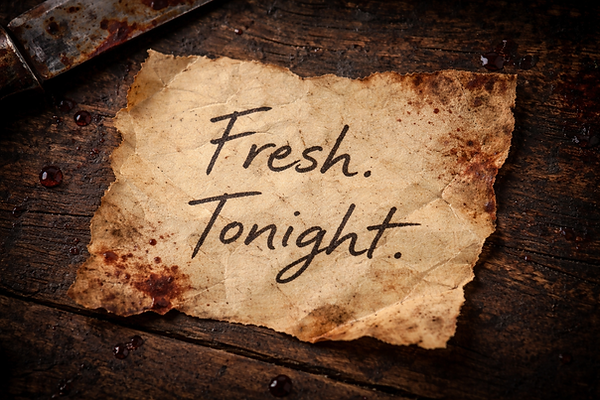
Fresh. Tonight.
My hands shook.
I sat in my truck, staring at the house at the end of the street. The porch light glowed warm. My daughter’s bedroom window was soft and yellow.
Safe.
Alive.
My phone buzzed again:
Running out of patience.
I looked down at the empty bag on the passenger seat.
Clean.
Ready.
Monsters don’t care about rules.
Rules are for people.
The payment had already cleared.
T.W. Gill is an author of dark fiction who leans heavily into the Southern Gothic tradition and the darkness that lives in all humans.
Mother of the Night by Justine Rummage

In the bone-chilling cold, Drew ran until his legs ached. His breath hung in the air like smoke. The trees seemed to have eyes, and he could hear them squeak, though the wind lay still. Time had become an illusion, and it never seemed to get light. He felt as if he had been climbing and descending hills forever, lost in the endless, vast forests of West Virginia. He had grown up hearing the old tales of these mountains—stories he loved. He became obsessed with cryptids, traveling far and wide in search of them. Yet he had never found anything mysterious… at least, not until Morgantown. He pressed himself against a tree. The forest was so silent that his own breathing sounded like an explosion. His heart raced as he tried to make sense of what he had seen.
He had come on a camping trip with a few old college friends to search for the Ogua, a legendary aquatic monster said to live in the Monongahela River. One evening, he went on a quick solo hike. He had always enjoyed solitude in the evenings, a chance to gather his thoughts, something he now deeply regretted. When he returned, his friends could neither see nor hear him. For a while, he thought it was a prank. That belief was shattered when he saw them speaking with the police, joining search parties. He heard their screams and pleas for him to return, but no matter how loudly he shouted or how close he came, he could not reach them. Now, with all his might, he regretted his fascination with the supernatural. In retrospect, it all seemed like a sick, twisted nightmare. In the past, he had sworn he believed in a mythical world—that these legends were real. But now, after meeting her…or it…he realized he had never truly believed until he walked upon lands of gods and monsters.
Drew shivered as the trees squeaked again. This time, they formed whispers—not just whispers, but warnings.
“Runnnnn, childddd,” they sang.
“She’sss hereee, childddd. Mother is here for you.”
Suddenly, she appeared—not fifty feet away. Though it was nearly pitch-black, he saw her pale skin glow faintly. She wore a long white dress full of holes. Her hair was black and matted. She had no eyes, only empty sockets. Drew assumed she was blind—but she looked toward his hiding tree. He felt her terrifying energy stir something deep within him. He bolted before he could light a match. His flashlight had died earlier. As he ran through the darkness, the trees snickered and chanted, “Run, child, run! Mother is coming for you!”
Drew’s foot caught on a root. He fell face-first into the cold, hard ground, shattering his glasses. Something grabbed his feet. He struck a match and saw the root had wrapped around him, binding him. Two headless girls stood before him, wearing gold-and-blue cheerleading uniforms that looked straight out of the 70s, each holding her own head. Both had empty sockets where eyes should have been. The trees’ laughs were vile and wicked. Dozens of headless figures emerged from the darkness—some climbing down from trees, others clawing out of the ground. They all carried their heads, and though they had no eyes, they stared into his soul. His heart pounded. Out of the corner of his eye, a dark figure appeared, sending chills down to his bones.
Fear overran him. He thought of his mother and cried out. The figure descended slowly, and the forest fell deadly silent. Drew felt a crushing weight on his chest. Each step she took pressed heavier on him; her breathing grew louder. She finally loomed over him, and he could not bring himself to look up. Suddenly, the decapitated figures raised their heads and began to sing. The lyrics made no sense—they were in another language, like the tongues spoken at church, but far more sinister.
His heartbeat sounded like thunder. He prayed to God. The trees responded:
“Only one God exists here, child…and she is here for you.”
Their laughter ran shivers down his spine. The headless figures gathered around, chanting as if in a procession. Tears ran down his face. His body betrayed him as warm liquid rolled down his legs. He just wanted to go home, to wake up from this nightmare, but deep down, he knew the horror was real.
Crouched, he felt a deathly cold wind and a presence before him. It was the feeling you get when waking from your worst nightmare—multiplied a thousandfold. Trembling, he dared a glance upward—and instantly regretted it. She was the “Mother” they had spoken of. She held an axe and lifted it over his head; suddenly, everything went pitch black.
A few moments later, he awoke and was carrying his own head. The chants he couldn’t understand before were now clear as day to him:
“Only one mother, she walks among the forest.
Our Mother of the Night.
Leader of the terrors.
Though we are blind, she leads us through the darkness.
Goddess of death and destruction.
We find the downtrodden.
The lost.
And the weak.
We steal their last breath.
And join them in our fight.”
A powerful desire surged through him, and he wanted nothing more but to worship his new mother. She held a dark, magnificent power that consumed him. All he wanted was to obey her, to give himself completely to her will. He began chanting with his new brothers and sisters, their voices rising in eerie harmony. As Drew joined in, a terrifying hunger welled up inside him, which was to kill, to please his mother. Restless to fulfil his cravings, he led his family back to the campsite.
Justine Rummage is an author who enjoys creating poetry and short stories. She crafts her short stories to bring characters and worlds to life. Her work has been featured in Lothlorien Poetry Journal and Prosetrics The Magazine. When she’s not writing, you can usually find her dancing or spending time with her two cats. For Justine, literature is where she feels most creative, and she’s always looking for new ways to connect with and entertain readers.
Abraham's Chain by Mark Henricks

Abraham Scott was dead. His work-worn hands relaxed their grip on the chain that looped around his neck and over a sturdy oak branch. His dark-skinned body, strong from labor, scarred by the whip, became still. The youthful, handsome features displayed surprise, shock, and pain.
The tree stood in a clearing lit by a circle of kerosene lanterns. Flickering light illuminated his executioners as they leaned shotguns against wagon wheels and exchanged grim nods. “Using the boy’s own chain was a nice touch,” one said.
A young woman with pale skin and curly yellow hair stood among them. Her gray-striped skirt swept the ground. A long, ragged rip marred the front of her white high-necked blouse. She held the torn edges closed with one hand while dabbing her eyes with a handkerchief.
A tall man who looked to be the group’s leader spoke. “I reckon you’ll be the last white woman he attacks, Miss Elizabeth.”
The woman stared into the dark forest. “I didn’t want him killed,” she said softly.
“He surely attacked you, no matter what he said,” the man said. “Or how’d your shirt get torn?”
She stared at him. “What do you mean?” she said, her voice rising. “Do you think I tore it myself?”
“Never mind,” the man said. “You’re a Fitzpatrick. That means you’ll get justice.”
“I didn’t want him killed,” the woman said again. She repeated her words while they got into the wagons and drove away. Though there was no breeze, Abraham Scott’s body swayed, and the twisted chain emitted a sharp rattle.
###
Tyler Haraldson stood in the shade of the big tree in his front yard, his 10-year-old frame tense. His next-door neighbor and new best friend, Betsy, yelled, “Go!”
Tyler sprinted across the yard and dived headfirst into a huge heap of red oak leaves. Inside the pile, it was twilight. Dust filled his nose with a musty, woodsy smell.
He reveled in the leafy cocoon for a moment, then crawled forward to emerge from the other side. As his head poked into the sunlight, something wrapped around his left ankle. It felt cold and metallic, but also somehow alive, as though testing to see if he was the right sort.
He yelled and jerked his leg up. The grip on his ankle relaxed. He leapt forward and sprawled onto the prickly, cropped lawn of the brand-new suburb. He looked back at the pile and felt an icy block of fear in his stomach.
“Here I come!” Betsy shouted.
Tyler stood and held up his arms. “No! Stop!”
Betsy skidded to a halt. “What?”
“I’m not sure,” Tyler said. “It was like something grabbed my foot.”
Betsy laughed. “Are you scared?” she said. “Want your mommy?”
A flush spread over Tyler’s face. “No!” he said. Shame and anger had replaced his fear. “It was nothing. Come on!”
Betsy ran and dived headfirst into the bright leaves. She and Tyler had raked up a pile as tall as they were.
His dad said the tree they fell from had been there for over a hundred years. Tyler and his family had moved in over the summer, but Betsy’s family had been living in the area “basically forever,” according to his dad.
In front of him, Betsy’s hand shot up from the pile. Then it jerked backward. Surprised, Tyler stepped forward and grabbed her wrist. It slipped, but their fingers met and clasped. He leaned back and pulled as hard as he could.
Nothing gave at first. Then Betsy popped out, shaking leaves from her blonde ringlets. She frowned and looked down.
“My shirt got torn,” she said, fingering the edges of the rip. “It was like you said. Something caught it.”
“Who’s scared now?” Tyler said. He still felt ashamed.
“Not me.” Betsy shook her head emphatically. “But I don’t want to do this anymore.”
“One more. Go on.” Tyler felt he couldn’t let her off the hook now.
“I don’t like it,” Betsy said. “I’m not going again.”
Tyler pressed. “Don’t be a baby. I did it.”
“Oh, all right.” Betsy ran across the yard and turned around.
“Go!” Tyler called.
Betsy charged, white legs and arms churning, and dived into the leaves. For a moment, the pile was still. Then the mound rustled and bulged. Tyler heard her cry out, along with a clanking sound. The leaves went quiet. Betsy did not emerge.
Tyler ran into the pile, kicking leaves aside. Frantically, he crossed again and again, each kick turning up only more leaves. Then he stopped, panting. He opened his mouth as if to call out, then closed it. He began walking slowly toward the house. He looked back once, then kept walking.
###
The police had gone. Tyler had told them that Betsy said she was going to the convenience store for a soda, then walked around the corner. That, he said, was the last time he saw her. Betsy’s parents had driven off behind the police. Tyler and his father were alone.
“Don’t worry, Ty,” his father said. “Let’s bag these leaves. I’m sure she’ll be back in time to help us finish.”
Tyler looked at the pile and frowned. “You rake,” he said. “I’ll hold the bag.”
“Deal,” his dad said. “Someday you can do the same for your son.”
###
Betsy had not returned by the time Tyler stuffed the last rake into a bag. As he did, he saw something dark and twisted lying among the bright red flakes. He picked it up. A length of rusty chain. It rattled and seemed to squirm in his hand, and he hastily threw it down. He backed away, wiping his hands on his pants.
“Something wrong, son?” his father asked.
“I didn’t mean for this to happen,” Tyler whispered.
Just then, a car came around the corner. His father pointed. “That’ll be the Fitzpatricks, back from the police.”
Tyler looked where his father pointed. Behind him, the chain settled into the grass, waiting.
Mark Henricks is a freelance journalist in Granbury, Texas. In his spare time, he performs as a guitarist and singer in an acoustic duo, competes in sprint triathlons and whenever possible engages in adventures involving backpacks, kayaks and motorcycles, usually not at the same time.
Offal by Allison Westphal

The citadel canted like a gutted beast, stone ribs naked to the sharp air, snow hesitant on the breeze. It leaned, abandoned, for as long as still living could recall, a grim reminder biding in the gnarled forest. A reminder of what the villagers couldn’t agree on.
Across the vale had been a lean summer, thin crops, and withered creeks. Fresh meat came by so rarely. A wind, tainted with cold ammonia, quickened the gnawing hunger of the townsfolk, a faint salivation of iron stirring deep in their palate.
The citadel endured, a reminder, nonetheless.
Age’s crush had worn the stone foundations, puncturing the grounds with gaping holes, clamoring like the yawning mouths of ravenous fledglings. And in those bores, a greasy light fluttered, as shouts issued from the breach, dissipating into the fog.
Ared, a waxen, tall man, held high his torch. “Goddamnit, Burga, check again. The map says we’re in a larder.” He coughed, smothering his bark with a tatter from the reek that sloughed from the walls. “I hope if we find anything, it’s better than this tripe.”
His companion, a musclebound woman clad in leather, wrenched a cask apart. Its staves clattered to the ground. “Not in this one. What about you, Jalex?”
Another, a longshank wreathed in black, topped with a gleaming helm. “Nothing left here. It’s been scavenged. Wolves, most like. Or something worse.”
Their final member clutched her staff, skirting the dancing shadows. “I agreed to assist on the condition that knowledge was to be had, Ared. I see neither great books nor libraries.”
“Fine, Malia,” he grunted, sifting through the molding straw diffused across the blackstone floor. “Head home. See how that fares. Or stick it out with us and fill your belly at least.”
The woman clutched across her stomach, hand strangling her dirty blue robes. “You gave your word, scoundrel.”
He laughed off the insult, hands scuttering among the straw. “My word and two coins will buy a trip on Kharon’s ferry. Now c’mere, Burga. Help me with this.” The pair of them heaved, lifting up the thick hatch, a further stain of darkness among the shadows.
Ared descended the decaying ladder, feet light in anticipation of a false rung, and the group followed once his torchlight found purchase in the gloom. They stood, breath visible in the earthen-dank space.
“It’s a root cellar,” Jalex said, hand worrying at his hilt.
“Maybe there’s less rot, then,” said Burga, and strode in.
Kegs serried the walls. Jalex claimed the first finding, raising a glistening haunch, pulling it dripping from the salt it was packed within.
“See?” Ared said. “We’re in some bygone monarch’s cellar. There’s bound to be more.”
Malia cowered as further flesh manifested, drawn from barrels and heaped onto a procured bindle. It wasn’t long before a feast rose on the bedroll, smeared with lard.
Ared spoke from the dark. “Now this deserves a reward. Anyone fancy a roast?”
“In the next room, there was some sort of brazier,” Jalex said.
The spit set up and the cavernous hall aglow, Malia tried to relax. The brazier stood, as promised, but it was a massive bronze pan with pillars up the sides, forming an unsettling monolith. Still, charred logs already crusted the center, which lit when prompted.
The flowing sear-scent wafted over them, and her gullet shuddered. Fresh meat came by so rarely, and the group slavered over the smell. Still, she waited last to take her slice. She sat, staring at the succulent fat gleaming in the dancing amber light.
“Scholar,” said Burga, her mouth crammed with flesh. “What’s the writing?”
“What writing?” Malia said.
“On the floor,” the woman grunted.
She peered down, and there spread a faint glyph. Its companions ran the length of the room, choking the brazier. Red, painted onto the uneven stone floor in a mad scrawl.
“What do they say?” Ared asked.
Her words moved faster than her mind.
“Bind this flesh and tear it ‘part, break now the bone and ere the heart,” she said.
“Floor poetry. Never thought I’d see it.” Jalex remarked, taking another sticky bite.
“For endless time the Carver’s sealed, lest you partake of his last meal…” she finished, eyes tracing the circumference of the symbols.
“What does it mean, then?” Ared said.
“It’s a spell…” she whispered, drawing in apprehension. “It’s a spell! Stop eating, stop fucking eating!”
She felt the ley lines snapping free, spindling apart.
“Calm down, love. Here, it’s delicious.” Ared dangled a gobbet at her.
The pit flared. Their faces turned, grease shining around their open mouths. Behind the conflagration, a set of leering eyes peered forth, the veil of the world fraying and splintering.
Malia shrieked.
Faster and sharper, a barb shot forth from the fire, impaling Burga. She smeared across the floor, trailing a heavy iron chain. It pinned her to the far wall. She palpitated vainly like a wounded animal, then succumbed.
The meat-scent soured, now putrid, as the chain snapped taut, pulling forth from the depths of the inferno a corpulent thing. Hand over unctuous hand, it shucked open its arcane prison, travailing once again into stark reality. It stood taller than any man, a lurid cleaver in its right hand, the chain wrapped around its left, twisting black horns scraping the vaulting.
The group stood, frozen.
It bellowed, spewing maggot-breath, clogging the room. Malia found she had been shorn of motion, impaired by the pungency, and she followed with watering eyes as the beast cut into her companions, dismantling them with practiced ease, reduced to piles of quivering flesh.
It stopped, then, sniffing at the air. Malia watched in gnawing terror as its loathsome face, a twisted malformation more like a pig than a man, grew close. It snorted again, inhaling her fear then bathing her in fetid breath, and held out a shank of what might have been Ared, still weeping iron-tang scent and matted with swarthy hair.
After all, fresh meat came by so rarely.
Allison Westphal is almost a person and definitely a Creative. She’s worked in the often-dying video games industry, chases cats, fancies herself a decent movie critic, and just can’t seem to kick her writing habit.
Now I Am Six by Lisa Baker

Mommy’s head smacked off the kitchen faucet. Her hand went straight to the cut. She didn’t say ‘ouchie’. She never says ‘ouchie.’ She grabs the dish towel and presses it to the cut. It’s the one with pretty flowers around the edges. It used to be bright white, but now it’s yellowy-grey, and she’ll probably have to throw it away ‘cos it’s got blood on it.
I stay in the corner with my back to the wall. Daddy’s still here. He pulls a chair out from under the table. It’s really loud when he scrapes it across the floor. I don’t like the sound, so I put my hands over my ears. He sits and takes a cigarette out of his top pocket and lights it. I hate the smell. It’s like the time Terra-Rose pushed me when I wouldn’t let her have my ring pop. I fell in the mud where it was always muddy, even when it’s hot, and everywhere else the grass is brown. The smell wouldn’t go away, and I felt like I couldn’t breathe.
He slams his fist on the table, making his empty beer can tip over.
“It’s your own fault. Always crying and bleating and going on.”
I listen as the can rolls to a stop in front of the big brown ashtray. Mommy is whimpering, and Daddy sucks his cheeks in as he smokes. His face is puffy, like the papier-mache dolls we made at school. Mine was meant to look like a clown, but I picked it up too soon, and the paint ran down its face.
Mommy is making supper. She has a pan on the stove ready to fry some meat. She never makes Sloppy Joes anymore ‘cos daddy doesn’t like them. They’re my favourite.
He was hot mad when he came in. Mommy didn’t say anything, but she still lowered her head. I don’t know why, ‘cos she’d done her makeup to cover the bruise. Daddy had hit her hard when she asked if they could move. Said she needed a “fresh start.” Said how much better it would be to have gas and big stores nearby. I could see him getting madder. You can tell ‘cos his legs start twitching. He went off like someone had shaken him up and popped his lid. He never hears me when I scream at him to stop.
Mommy used to put makeup on to look pretty. She had a ruby-red lipstick that made her mouth look like she’d been eating popsicles. Sometimes, when she was busy, I would go and try it on. My mommy did it for me the day of my birthday party. She painted my nails pink too, to match my pretty dress. I got that dress on now, but it’s wet. Drips fall from the hem, and it looks like my dress is crying.
Daddy gets up and opens the fridge.
“Jesus Christ. Can’t a guy have any beer in his own house?”
Mommy shrinks. Her face hidden by her hair. She used to wear it in a ponytail, but now it hangs around her face. It looks greasy.
“I’ll go get some,” Mommy says quietly. She puts the towel down, grabs her purse, takes a Blue Jays baseball cap from a peg by the door, and pulls it down to cover the cut. “I won’t be long.”
“Can I come, Mommy?” I ask, walking toward her. But she ignores me, and I’ve left a trail of water on the floor. “Please?” I shout. But she is already in the truck. I walk past Daddy. He’s lighting another cigarette and doesn’t notice the pools of water I’m leaving behind.
I return to my place by the wall. Daddy’s cigarette crackles as he sucks it before the smoke comes out of his nostrils. He looks like a dragon in one of the stories Mommy used to read to me, with evil red eyes and scales like swords.
There’s a pop of fat from the pan. Mommy must’ve forgotten to turn the stove off, and it’s spitting and spluttering. Daddy cusses. As he stands, the towel with the flowers starts to smoke, and small flames flicker upward. Mommy must have been in a real big rush to get the beer.
Daddy tries to grab the end of the towel, and I watch his heel slip on the pool of water I left behind. He tumbles, his head smacking the edge of the table. Daddy doesn’t say ‘ouchie’ either. He falls to the ground like the bag of flour Mommy used to make my birthday cake. He’s lying there, and the pan is really smoking, like the first fire of the season. The towel’s burning, and the pretty flowers are swallowed by the fire. I like the way the flames move, like the people dancing at the Fire Hall parties. Twisting and turning but never tripping over each other.
I watch. The fire gets bigger.
Mommy won’t be back for a while, since those stores aren’t nearby.
###
Mommy looks at where our house used to be. There are wisps of smoke like those from Daddy’s cigarettes circling upward. I reach out and hold her hand, but she doesn’t squeeze it back. I think she is happy because she can move to the town now. Just like she wanted.
“Damn sin,” says a firefighter, black marks streaking his face. Another firefighter nods in agreement.
“Fire spread to the propane tank. Went off like a grenade. Poor woman has no luck.” He spat. A frothy globule fizzing in the dirt. “Last time I was here was for her kid.”
“Yeah?”
“Yeah. Poor kid. Drowned in the lake at the bottom of the yard. Worse of all, it was her sixth birthday.”
Lisa Baker is an English immigrant living in Nova Scotia, Canada, with her partner, son and two naughty but adorable rescue dogs. She holds an MA in Literature from Dalhousie University and an MFA from the University of King’s College, where she found her wonderful writing family. When she isn’t writing, she is thinking about writing or following her favourite English team, Coventry City Football Club. She can be contacted at www.lisabaker-writer.com and https://www.facebook.com/LisaBakerWrites/
My Sister Elsbeth by Antoinette Bekker

In 2005, my sister killed a man.
We were born in 1995, identical twins. My mother, who conversed with foxes and horses, died three days after giving birth. My sister died too, but she made it to twenty-one days before she left her body behind. Ever since, she has a fondness for the number three. Three times seven is particularly powerful, or so she claims. Perhaps that’s why she stabbed Phillip Jones twenty-one times.
My granny raises us. Granny is a witch and a veterinarian. She cures anything from hairballs to colic, except for her daughter’s sepsis. Late at night, she talks to God, weeping about ravaged bodies and the evil of men. “Revenge, Lord. Give us justice.”
Hiding underneath Granny’s bed, we see the candle flicker.
“I told you!” Elsbeth says.
“Told me what?”
“God’s breath makes the candle move.”
Elsbeth grows up without a visible body. Visible to others, that is. Being twins, we are bound, and I see her. Granny says our connection is uncanny. Elsbeth wears my clothes and takes my things. She wants a body because being a weak, wispy thing makes her mad enough to frizz the cat’s tail. Granny says my sister is a spicy pepper when she gets in a temper.
“It’s a good thing Elsbeth is a ghost,” says Granny and takes a drag of her roll-up, “because her freaking out in a physical body would be chaos.”
Loving horses runs in the family like luck. We love Arthur, our nineteen-hand Percheron, whom Granny won from Phillip Jones in a game of Texas Hold’em. Phillip Jones breeds horses on weeds and dust. The ones he cannot sell, he sends to the abattoir at Fort McLeod for ten cents a pound. Granny says the land and God remember men like him.
“Stay away from that man when we are at the show!” Her frown is as deep as the coulee behind our house.
“Why?” Elsbeth asks, swinging upside down, her legs hooked over the gate, my dress covering her head, and my panties getting air.
“Elsbeth’s indecent,” I snitch, but Granny, braiding Arthur’s mane, is in a snit over Phillip Jones, who has entered Arthur’s brother in the show.
“Garr,” she grumbles. “Pitching brother against brother. Phillip Jones is a vile, vile man.” She points the body brush at me. “Tell your sister to behave.” She tugs at a wayward piece of mane. “Just because I can’t hear or see her, doesn’t mean she gets to be wild.”
Later that day, at the showgrounds, Granny develops one of her migraines when Phillip Jones stops to look at Arthur, and then at me.
“Nice horse, Josephine,” he says. “And your filly’s growing. Just like her mother. Is she for sale yet?” His laughter follows the tassels on his chaps, swinging with each stride.
Granny’s eyes bulge. She runs and vomits behind a saskatoon berry bush, making a sound like something breaking loose. “Will you be all right, child?” She fumbles for her sunglasses. “I need to lie down. My head’s going to explode.”
“Of course, Granny.” I hug her twice, once for me and once for Elsbeth.
“Stay away—”
“Yes, Granny.”
“Be careful, love.”
I’m in the horse trailer fluffing straw when I feel the ramp shudder.
Phillip Jones. “You are all legs.” He moves closer.
I step back, squeezing the pitchfork to my chest. Shadows hover, and I imagine I see the shape of Elsbeth’s jawline in his face.
“I like your hair.” I push against the trailer wall when he pulls my braid through his fingers.
His right ear has a notch out of the rim, like somebody took their teeth to it. He notices me looking. “Are you also a biter?” he asks.
“Get away from me.”
“Or what?” He grabs the pitchfork and drops it in the straw.
When I feel his thing against my thigh, I twang the string. My sister floats in.
“Help me, Elsbeth,” I ask, unsure what my scrap of a sister can do.
But Elsbeth, the spicy pepper, glows red and seems to harness her energy. She lifts the pitchfork. My breath catches when it almost slips, and then she runs down the ramp. I hear the slap-slap of her feet.
“Elsbeth!”
She returns. Picking up speed, she holds the fork like a knight with a javelin.
Phillip Jones smiles, and his cheek dimples. “What are you looking at, sweetness?”
That’s when Elsbeth stabs him for the first time.
###
“We have to clean up.” I pluck the pitchfork from the straw and scrub it at the trough until the water runs clear. Elsbeth, see-through again, rests in a wheel well, humming a ditty. Arthur neighs, wanting to know what’s going on.
“Go tell Arthur everything’s fine.” By the time Elsbeth whizzes back, the fork nestles between the brooms and spare halters, all locked up in the tack compartment.
Once home, I hang the pitchfork on the west wall of the barn, between the bridle hooks and the rosary Granny keeps for difficult births.
Granny asks what really happened that afternoon.
“Nothing, Granny. Elsbeth and I fed Arthur, I cleaned the trailer, and we walked to the hotel. It was only two blocks.”
Granny nods. “Mmm.”
“Mmm, what, Granny?”
“Phillip Jones,” she says. “His face...”
“What about it?”
Granny forks hay into Arthur’s stall. “It looked like he saw a ghost.”
Elsbeth laughs then, sharp and delighted. She balances on a rafter in my nightgown and gumboots.
“I always wondered when he was going to come for you.” Granny kisses her fingertip and touches it to the dimple in my cheek. Her hand smells of horse. “Now he’s gone.”
That night, leaving Granny with her flickering candle and Elsbeth curled up with the cat, I go back to the barn to check on the horses. The pitchfork hangs on its hook, and, like every evening since, I straighten it.
Antoinette is an emerging writer from the prairies of Alberta. She holds an MFA in Fiction from the University of King's College. Her work has been provincially awarded, published in literary magazines and longlisted twice for the CBC Creative Non-fiction awards.
The Dead of Winter by AJ Atwater

Going to Vince and the kids in our trailer house in Broken Homes Trailer Park in Slingshot, and I have nothing by my side but a bag of blemished oranges from the general store. It is the dead of winter. It is 1970. Eight feet of snow blocks the pass. Our only way out. The snowplow with supplies is months late. Wild-eyed, the married Lennon twins sleep with the married Nelson brothers. Vince is banging Lily Benson. Barbie Johns sleeps with the preacher of our Savior Church, and Lucy Lewis, out shoveling snow one evening, looked up, and there was Lily Benson’s husband, zipper down. She took him in her mouth, she said, then and there, cold regardless. A man was murdered last night with a splitting maul when he didn’t satisfy. The murderer took up the maul and killed the man. He was the son of the general store owner. His battered body is hanging in the meat freezer, the same freezer where the skinny pork chops we hunt desperately through are wrapped in white butcher paper. Then there he is. The son of the general store owner was looking at the pork chops as if he wanted them as much as he had wanted his maul murderer. When the ground thaws in the spring, we will bury him, the general store owner’s son, in the cemetery next to the church where headstones are tipped and broken. But we will not make it until then. Our root cellars are empty. Our lamps are out of oil. Our trucks are out of gas. Our woodstoves are cold. The general store closes down. The dead general store owner’s son is left on his own. Our children are lost in the woods. On the altar of our Savior Church, slingshotters, wild-eyed and more crazed than ever, bang those who are not theirs. Then the maul murderer is at the church door looking for the general store owner’s dead son. Walks to the altar, wild-eyed. Searching for the dead man. Those on the altar don’t see it at first. Don’t see the splitting maul in my hands. I slash it up in the frigid air above me and bring it down over and over. The sun breaks through the clouds and shines through the church's stained-glass window. Then I hear it: The snowplow breaking through the snow-clogged pass. The snowplow operator opens our Savior Church door, sees me throw the splitting maul into a corner, and I am the first out the door. The only one out the door, the snowplow operator later tells the court, and he bows his head at the carnage he had seen as he points an accusing finger at me in the cold of a courtroom two hundred miles from Slingshot, population 0.
Atwater’s fiction is published or forthcoming in Eckleburg, American Literary Review, Gravel, LitroNY, Roanoke Review, Blood Tree Literature, Gargoyle, Bull and others.
A Walk in the Woods by Cynthia Pitman

No good ever comes out of a walk in the woods. Sure, there’s the fresh air, the soft breeze, the gentle brushing sound of the tree leaves, the chirping birds, and the quiet crack of the leaves and sticks underfoot on the trail. All that’s good. But before you know it, you could be slumped in the slimy mud and bones at the bottom of an abandoned well, both feet hobbled, blood seeping from a knife wound in your stomach, and no one around to hear your cries.
Let me explain. That day, a beautiful one, I decided to go hiking up the mountain through Crow’s Creek Woods. First mistake. Everyone knew something evil lurked there. Then I decided to go alone. That’s a well-known mistake that even experienced hikers like me shouldn’t make. But I made it. I packed enough supplies for the day in my worn backpack, including my hunting knife and a rope for climbing, put on my usual hiking clothes, and set out. It didn’t take long to hit my stride.
Because I knew the trail so well, I was free to look around as I walked. Mist still clung to the woods, but it was rising. As it did, I stopped. I saw something up the trail. Something bulky, moving toward me. I stood still, wondering if I should turn and run. But as the something got closer, I could tell it was a man. A big man. He was walking at a good pace, getting nearer and nearer. As he came close, he held a hand halfway up.
“Hey,” he said.
I stayed still and quiet.
“How ya doin’?”
I gave him a quick nod. He came closer and held out his hand. I extended mine to shake his, but he grabbed mine first. I’ve always thought I had a pretty firm grip, but this guy crushed me. I had to look up to see his face, but the sun was rising behind him, and all I could discern was a dark silhouette.
“Say, you wouldn’t happen to know where Creekbranch turnoff is, would you?” he asked.
I nodded yes.
“You’re heading up the mountain, right?"
Again, I nodded yes.
“Well, I’m coming down. I was supposed to take the turnoff and meet my girlfriend at the end of that trail, but I must’ve missed it. If I follow you up, will you show me where it is?”
I swallowed and made myself speak. “Yeah, sure,” came cracking out of my mouth.
“Great! Thanks. Just lead the way. I’ll be right behind you.”
He stepped beside me. I saw his face. Wrinkles and pocks covered it. His hair was tangled, and he had a scraggly beard. He wore a flannel shirt, thin with age, ripped blue jeans, and dirty sneakers. Everything wrong for hiking. Then I noticed he had no backpack. That was really odd for a hiker. As he stepped behind me, I felt a shiver crawl up my back.
But I started walking. He stayed close behind me – a little too close, I thought. We kept an even pace. Then I heard him murmuring. What he was saying, I couldn’t tell. But he was forceful about whatever it was. Then I heard him laugh and burst into song:
“Cigarettes and whiskey and wild, wild women
will drive you crazy, will drive you insane!”
He laughed again. Then he said to me, “Hey, how much longer? Shouldn’t we be there by now? My girlfriend isn’t going to be happy if I don’t show up soon.”
I paused. I had to think. “Just a little ways more. Up past the old, abandoned cabin.”
“What? She didn’t say anything about a cabin.”
I spoke calmly. “She must have taken the long trail. A shorter one goes by the cabin. It’ll get you there faster.”
He mumbled something. I didn’t know what. We walked on. Soon, I took him onto the turnoff that passes the cabin.
“Man, look at that thing. I don’t know how it’s still. . .ack!” He cried out. Quicker than he could notice, I had spun around and stabbed him in the stomach with my hunting knife. Blood was pouring out.
“Wha. . .? What the. . .?" he said, then fell to the ground.
I quickly took his dirty sneakers off him, then took my knife and hobbled him in both ankles. He screamed and kept on screaming. I rolled him over and hogtied him with my rope. Then I gathered all the strength I had left and dragged him across the ground until I got to the old, abandoned cistern. I used a fallen branch to push the stone lid off. He was still screaming when I pushed him in. I heard him land, cracking his own bones and the bones of the ones that came before him. I then pushed the lid back on. No cries could be heard.
I thought for a while. Then I decided to go back down and follow the real turnoff to Creekbranch that we had long since passed. I wanted to meet the girlfriend. The guy in the well could probably use a little company.
Cynthia Pitman, author of poetry collections The White Room, Blood Orange, Breathe, and Broken, has been published in Flash Phantoms, Literary Yard, Bright Flash Review, Amethyst Review, The Ekphrastic Review, Third Wednesday (One Sentence Poem Contest finalist), Saw Palm: Florida Literature and Art (Pushcart Prize nominee), and other journals, and in anthologies Pain and Renewal, Brought to Sight & Swept Away, Nothing Divine Dies, and What is All This Sweet Work?
Vengeance by M. Conant-Carr

The fracking rig intruded into the Anadarko Basin's Woodford Shale in Oklahoma. Before the loud monster took center stage, this beautiful woodland theater showcased the music of birds and the screeches of long-eared bats. These little guys looked ferocious, with their sharp teeth and eyes that stared with threatening intensity. They foraged on the wooded hillsides and ridgelines for insects and hid in crevices and holes, showing only their noses and ears. Now, they screech angry curses from hunger pangs. White-nose syndrome was rampant, and the loss of their homes and source of food killed millions of their friends and family. The powerless survivors mourn their loss, but they are alone in their grief. No one cares. They have no champion among the giant two-footed animals, whom the bats hate. These murderous human animals live on the “big lighted tree which makes loud noises.” They don’t weep for these small creatures. These giants are killers, and the little bats dream of vengeance.
One of the human animals, Buck, works the night shift. He is a rig engineer on the “big lighted tree” and is a quiet, steady worker. His buddy, Tex, is not only a friend but someone Buck protects. Tex is his own worst enemy. He is a loose cannon, and Buck steadies him. Although born and raised in Oklahoma, Tex enjoys the cowboy image, complete with a ten-gallon hat, ornate leather boots, and loud western shirt, hence his name. He was always in search of an identity that would give him significance.
On this particular night, after dinner in the cafeteria, the men returned to their workstations as usual, but the strong winds and rain made the work challenging. No one complained. It all came with the job. Buck heard Tex’s gruff, western-accented voice over the intercom.
“What’s with that noise?” Tex asked.
“What noise? The wind? It's nothing new. You’re just noticing it now? Sometimes you're weird, you know that? I have to get back to work, and so should you,” said Buck, with a half grin, and shook his head.
Tex didn't always have the best judgment, like when he got into high-stakes poker games while on the clock. Hours passed, and Buck hadn't seen or heard from his talkative friend. Tex had been working out of Buck’s sight for too long, and his usual position on the rig was supposed to be in view of his friend. Buck hoped he wasn't gambling on work time again. The boss would fire him if he was caught. Buck had warned him repeatedly, but Tex was addicted. They are paid well to work on the rig. It was their dream job…until that night. Tex can't afford to lose it, and Buck didn't want to lose Tex. The workers on the rig had to spend long weeks away from family, so their co-workers were like a substitute family.
Buck was a patient guy, but he was getting fed up. He left his work area to find Tex and deliver an ultimatum: “Knock it off, Tex, or I have to report you.” He had his speech all worked out by the time he reached the doorway to the cafeteria. He opened the door, expecting to see Tex and his fellow delinquents engrossed in poker hands. Instead, he stared with horror at the broad blood smears covering the floor and walls. Was this some prank? No. This was real blood, and there was still no sign of Tex. Then Buck heard a screech he still hears in his nightmares, every night since the rig was shut down. It pierced his brain like a hot knife. And when he relives the screech, which is most nights, Buck also sees the giant nose and pointy ears that emerged from the doorway of the cafeteria and the crazed eyes that glared at him. The most horrifying sight, however, was seeing Tex’s bloodied western shirt held in the fangs of the fifteen-foot-tall bat.
M. Conant-Carr is a writer and avid reader in Savannah, Georgia. Her writing focuses on humorous and psychological horror, allegory, low fantasy and historical fiction. She is currently working on a first novel and has completed several flash fictions and poems. She draws from her many years of experience as a Psychiatric Nurse Practitioner in private practice.
Stillness by Ria Cabral
The first thing Mara noticed when the power went out was the quiet.
Not the gentle, late-night quiet she was used to, but a pressure—like the world had inhaled and forgotten how to exhale. The refrigerator’s hum died. The air vent stopped breathing. Even the distant traffic that usually whispered through the walls of her apartment vanished.
She stood in her kitchen, phone in hand, staring at her own reflection in the dark window. The screen glowed weakly: No Service.
“Okay,” she said, just to prove she could still make sound. Her voice felt too loud, too exposed.
The blackout wasn’t unusual. Storms rolled through every summer. But when she flipped the light switch again—harder this time—and nothing happened, a small, sharp knot formed behind her ribs.
Minutes passed. Then an hour. Her phone battery slipped from 63% to 61%.
She tried the door. It opened, but the hallway beyond was black, thick as pitch. Someone down the corridor was crying. Or maybe laughing. The sound echoed wrong, stretching into something shapeless.
“Hello?” Mara called.
The sound stopped instantly.
She closed the door and locked it, heart hammering. The silence rushed back in, heavier than before, like it had been waiting.
By morning—she assumed it was morning; time had started to feel theoretical—she realized something worse than the blackout.
Her body wouldn’t do what she told it to.
It started small. She reached for a glass of water, and her hand paused mid-air, fingers trembling, hovering inches from the rim. Her arm burned with effort, as if she were holding a weight far heavier than bone and muscle.
“Move,” she whispered.
Nothing.
Then, slowly, her hand lowered. Not where she wanted it to go—just down, slack, as if the command had never existed.
Panic surged. She willed herself to breathe deeply. Her chest rose in shallow, uneven jerks, entirely out of rhythm with her thoughts.
It felt like being trapped behind her own eyes, screaming instructions at a body that had decided it no longer needed a pilot.
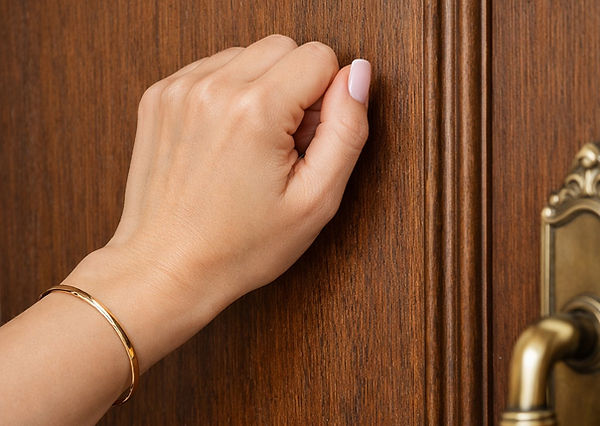
The knocking began that evening.
Three slow taps. Perfectly spaced.
She froze on the couch, knees drawn to her chest. Her legs had started doing that on their own, folding and unfolding in nervous little spasms.
“Mara,” a voice said from the other side of the door.
It was her voice.
Not a recording. Not an imitation. It carried the same tired softness, the same faint rasp she got when she was afraid.
“Let me in,” it said. “I’m so tired.”
Her mouth opened.
She didn’t want it to.
“No,” she managed, forcing the word out through clenched teeth.
The doorknob turned anyway. Not violently—just testing. Curious.
She felt her hand slide off the couch cushion and drift toward the floor. Her fingers twitched, reaching for nothing.
The knocking stopped.
“I’ll wait,” the voice said kindly. “You always give in eventually.”
Time dissolved after that. Days, maybe weeks. The darkness never lifted. Her phone died. Hunger came and went, dull and distant, like a memory of pain rather than pain itself.
Her body continued its quiet rebellion.
Sometimes she stood up without meaning to, joints snapping into place like a puppet yanked upright. Sometimes she lay still for hours, staring at the ceiling, unable to blink, tears pooling and slipping sideways into her hair.
She discovered she could still feel everything.
That was the worst part.
The cramps. The pins-and-needles numbness. The slow ache of muscles holding positions she hadn’t chosen. Her body was not failing—it was functioning perfectly, just no longer for her.
The knocking returned every so often. Always polite. Always patient.
“Mara,” the voice would murmur. “You don’t need to do this anymore.”
She started answering back, at first to beg, then to argue, then just to hear another voice—even if it was her own.
“Why are you doing this?” she asked once.
There was a pause.
“Because you’re tired,” the voice said. “And I can finish things better than you can.”
The night she lost control of her legs completely, she cried until her throat bled.
Her body carried her to the bedroom. Tucked her in. Folded her hands neatly over her chest.
The ceiling above her seemed closer than before.
“Mara,” the voice whispered—not from the door now, but from everywhere. From inside her skull. “You can rest.”
Her breathing slowed. She fought it, counting in her head, but the numbers slipped away, sliding out of reach.
She felt herself sinking, not into sleep, but into something quieter. Deeper. Like being buried under warm soil.
Her heart began to stutter.
She screamed inside her mind, clawing for any fragment of control, any twitch of defiance—but her body had already made its decision.
As darkness closed in, one final, terrible thought surfaced:
She wasn’t dying.
She was being replaced.
When the lights flickered back on in the building days later, neighbors found Mara sitting at her kitchen table, hands folded around a cold cup of coffee.
She looked… fine. Calm. Alert.
When they asked if she was okay, she smiled.
“Yes,” she said, in her own voice. “I feel much better now.”
And somewhere deep inside that body, buried far below breath and bone, something that had once been Mara listened—silent, aware, and utterly alone.
Ria juggles books, chocolate, kids, a wonderful husband, dirty toilets, neglected laundry, and a deep love for stories—though rarely in that order.
Another Slice? by Jane Ayres

I’m beautiful.
An exquisite work of art.
You want me.
Desire me.
You’re greedy for me.
You were greedy for her, too.
At first.
Taking the bone-handled kitchen knife – recently sharpened – you ease the wide steel blade into my luscious sugary softness, teasing out a substantial slice. You hesitate, glance at the bloody mess behind you on the kitchen floor, where, minutes earlier, you used the same weapon on her.
Take a bite.
Go on.
You know you want to.
Devour me, piece by piece.
The way you consumed them.
Gently, with palpable self-control, you raise me to your lips, savouring the moment when your eager tongue connects with the first mouthful of buttercream frosting, sticky raspberry jam seeping out, and oozing between your fingers. I melt on that tongue, the perfect alchemy of equal amounts of fat and sugar creating the temperature of human blood in a living body with a beating heart, flooding you with dopamine, tricking you into craving more. I may look appetising, but my kind is a delicious slow poison, gradually clogging arteries and rotting teeth. However, don’t let that stop you.
My creator knew the secret of divine cake – two extra eggs, organic unsalted butter, adding a golden richness to the texture – delightful to a discerning palette. Beating the mixture vigorously until it becomes creamy and pliable enough to do whatever is needed. So, when the extra, special ingredients are blended in, the flavours combine seamlessly, rendering me irresistible.
How do I taste?
Better than anything you ever ate before?
Tuck in.
Take another mouthful.
Go on.
After all, it is your birthday, isn’t it? I was made especially for you.
Eat me. Eat me.
I heard her talking on the phone after she mixed up the buttercream frosting. It was obvious from the conversation that she already knew what you did to the others. To her sister. She was on to you, had been secretly tracking you for months, before you met her in that cookery evening class. Did you think that was fate? It was part of her plan to stop you – until you changed the story.
She’d found your hidden diary, discovered the way you meticulously documented your actions, how you buried their remaining parts by the ant hill behind the shed in the manicured garden. She was actually smiling when she ended the call.
Convinced the evidence needed to secure a conviction was in her grasp, she sprinkled desiccated coconut and dark chocolate flakes, making the final touches to her elaborate celebration masterpiece. Singing some tragic final-act operatic aria in a melodramatic soprano voice, she didn’t realise you were standing in the doorway until it was too late. You withdrew the blade, struck again, her wilfully beating heart still pumping before she fell into your arms, that luminous smile still etched on her face. For a moment, you cradled her silky blonde hair, wiping away a single, salty tear. Then you let her drop to the floor.
Your hands are bloody, corrupting my immaculate vanilla surface, your hunger unstoppable. Licking each finger, you notice a flash of sudden movement from the corner of your eye. A lone red ant is scurrying purposefully across the tabletop. You watch for a moment before casually smashing it to a pulp with your fist. Switching your attention back to my mouth-watering richness, you plunge your hand inside me, withdrawing ravenously with an untidy, squishy lump to devour. Wandering into the lounge, you become aware of the ugly antique clock over the fireplace ticking loudly. You swallow another mouthful of cake as you glance around the room. Something isn’t right, but you don’t know what. Then you notice what’s missing.
Your father.
He should be on the mantelpiece, yet an empty space glares back at you. Accusing. But where is he?
On the phone, she mentioned your appalling family history, the way your twisted dad brought you up after your mother’s sudden disappearance. Love can hurt. Love does strange things to people. So does grief and suffering.
You get up, pace the kitchen, study the tidy, regimented shelves, the rows of carefully labelled blue tins. Flour – both self-raising and plain. Sultanas. Currants. The sugar in a sealed glass jar to protect it from those pesky ants that keep coming in from the garden. You never understand how they find their way inside.
You notice the overflowing pedal bin and rummage amongst the discarded butter wrappers, sticky eggshells, and food debris. Then you see it, pushed to the bottom, consigned to the rubbish. Heart pounding, you rescue the missing urn, panicking now, examine the grease-fingered lid, discover the precious receptacle is empty, save a scant residue of grey powder. Your face ashen, disbelieving, you swallow the bile welling up in your throat. Turning, you stare at what’s left of me – luscious and inviting – displaying myself proudly on the table. Perhaps you never expected your twice-baked father to taste so good. Discarding the urn on the draining board, you vomit in the sink. Are you wondering what other special ingredients she added? Raging, you smash jars, kick the bin, advance towards me menacingly, oblivious of your final victim splayed on the stone-tiled floor until you slip in the expanding pool of darkening blood.
You scream as your feet slide and you stagger, struggling to keep your balance, but you are already pitching backwards, your head hitting the heavy oven door, splitting your skull as wide open as the eggs she cracked earlier. Sprawled beside her still-warm, still-smiling body, like some deranged lover, you reach out, your life ebbing away.
I’m spoiled.
Defiled.
Deserted.
Except something is crawling inside me and over me, fiery-red, tiny, invading, taking, claiming pieces of me – crumb by crumb – for their store cupboards outside.
The last sound I hear is a police siren in the distance, as I’m relentlessly dismantled by a diligent cavalcade of ants and carried into the garden where the bodies are buried.
UK based neurodivergent writer Jane Ayres re-discovered poetry studying for a part-time Creative Writing MA at the University of Kent, which she completed in 2019 at the age of 57. In 2020, she was longlisted for the Rebecca Swift Foundation Women Poets’ Prize. In 2021, she was shortlisted for the Aesthetica Creative Writing Award and a winner of the Laurence Sterne Prize. Her first collection 'edible' was published by Beir Bua Press (July 2022). Her micro-chapbook 'my lost womb still sings to me' is published by Porkbelly Press (October 2023).
Miles McKewan's Final Moments By Carson Fredriksen

Miles McKewan usually paid no attention to the various posters decorating the lone lamp post by the bus stop. After working ten hours at the French restaurant downtown, he found he barely had enough energy to walk back to his apartment.
But as he felt the drops of rain touch the top of his hood, his eyes briefly scanned the pole and the various missing person posters that decorated it. He couldn’t help but focus on one particular yellow sheet. Or rather, he couldn’t help but notice the image that appeared on the sheet, and it was the face he saw in the mirror every morning.
“Th-This has just gotta be one of those look-alikes that everyone claims are walking around the world today,” Miles spoke quietly to himself. Aside from a homeless man sleeping in a doorway, there was no one around on the quiet street. However, the young man did notice a patch of fog slowly rising from the gentle river flowing beneath the nearby bridge.
Miles walked right up to the pole and scanned the sheet, hoping to read something legible that could put his mind to rest. But the only thing he could read was the word ‘MISSING’ followed by a name and a date.
Miles McKewan.
September 3.
“That’s today’s date,” Miles thought as a quiet sense of dread started to eat away at his insides. He bit at his fingernails even though he promised himself he was going to find a new way to handle his stress in the New Year.
He gazed at the photo again. At first glance, it appeared to be a regular photo, but when standing directly under the lamppost, the photo seemed slightly off. The figure’s eyes were stretched to their limits while its mouth was midway open as if he were about to say something.
“Or maybe scream,” Miles thought as a gust of wind washed over him, causing his skin to erupt with goosebumps.
He was just about to rip the piece of paper right off the pole and tear it in half just so he wouldn’t have to look at it anymore, when he noticed the person in the photo was wearing a black hoodie.
“Maybe if I get rid of this hoodie, it’ll just be some other guy,”
It was a pathetic lie. He knew it in his heart. But at that moment, he just wanted to be in the comfort of his studio apartment. His eyes fell upon the homeless man again as his fingers slowly unzipped his hoodie, now soaked with the light rain that had been falling.
“He needs this more than I do anyway,” Miles muttered to himself as he raced across the street. More than once, he blinked the cold water out of his eyes, but thankfully, other than an occasional car driving down the adjacent street, there was no traffic to worry about.
Miles didn’t slow his pace until he stepped under the stoop. He ripped off his hoodie, feeling the night air ruffle his white t-shirt, before he placed it on the homeless man as if he were tucking him in.
Miles half-expected the older man to open his eyes and sit upright like he was impersonating an 80’s slasher villain. But he simply muttered some words, his voice sounding as if he gargled gravel and whisky daily, before he turned his head to one side.
Miles let out a breath he didn’t know was trapped in his lungs as he peered behind him.
The army of lampposts lining the street turned on their lights as scripted, bathing the empty streets in a hazy yellow glow. He couldn’t be sure, but it seemed as if the fog was growing thicker as it poured over the street.
“Just a five-minute walk and I’m home free,” Miles spoke quietly to himself as he began to make his way down the street. If there were any eyewitnesses present, they would have seen his slender figure make it halfway across the bridge before it looked as if his body was fully enveloped by the fog.
The only sounds heard were the distant honking of cars and the gentle snoring of the homeless man in the doorway.
The shrill scream that ripped through the air was the last thing anyone expected.
The homeless man practically threw the hoodie against the wall as he bolted upright and stared back into the fog that had begun to envelop the street like a twisted version of a security blanket.
He peered through the fog for a brief moment before he felt his arms go slack at his side. His bottle of cheap wine shattered onto the street below while the paper bag blew away towards an unknown destination.
He turned and started to run, not wanting to get any closer to that...thing waiting in the fog. He ran past the lamppost so fast he failed to notice Miles McKewan’s missing poster waving slightly in the wind. Nor did he notice the black hoodie in the picture slowly fading away, revealing a white t-shirt.
Carson Fredriksen is a neurodivergent writer from Calgary, Alberta who often enjoys rummaging through his dark, albeit unique, imagination to enhance his everyday life. His work has been featured in the anthologies ‘Dark Canadiana’ & ‘Weird Tales to Haunt Your Reptilian Brain’. His short stories have also appeared in Macabre Magazine, Moonday Mag and Sometimes Hilarious Horror. He can be found at: https://www.carsonfredriksen.com
Next of Kin by Shannon Scott

Kelly turns up the emo playing in her earbuds and fixes her eyes on the laptop screen. The cursor blinks on marketing strategies. American fast-food chains are opening in Ireland like clover in springtime. Kelly’s job is to pitch the chains as a win-win for both countries: convenience, job creation, community building. The sticking point is imported potatoes. They don’t need local suppliers with a global overabundance. She’ll make the franchise partners want it anyway. She’s good at her job. The light in the plane’s cabin is dim, and most of her fellow passengers are sleeping soundly. Kelly’s eyelids ache to join the communal slumber, and soon her chin falls to her chest.
In her dream, Kelly stands in a field. The sky is overcast. A woman sings with an Irish accent, but Kelly can’t see her or make out the lyrics. She moves forward without looking down, realizing too late she’s stepped into a hole that becomes deeper as she falls, her stomach dropping, the singing growing closer and sharper, waiting at the bottom of the blackness.
Kelly wakes with a start, sweaty and heart hammering. The screen has drifted into sleep mode. Her reflection in the blackness reveals hollow cheeks, empty eye cavities, a sunken mouth. A face from the grave. Slamming the laptop closed, she reaches for the pills to ease flight anxiety. In her pocket, she finds the orange Post-it note with her mother’s scrawl, the names of her ancestors located in an old cemetery near the hotel. She stuffs it back in her pocket, locates the bottle, and shakes out more pills than she needs. She pops them all in her mouth and chews.
The female flight attendant taps Kelly’s shoulder, and she nearly screams. The woman’s features loom gaunt and expectant in the aisle. Did she ask her something?
“Coffin ships?” The flight attendant inquires.
Kelly yanks out her earbuds, silencing the music. “Excuse me?”
“Cheddar crisps?” The flight attendant holds out a bag of potato chips. “We call them crisps over here.”
###
At the hotel, Kelly dumps her purse with its accumulated transatlantic trash, snacks, and coins on the desk beside the teakettle. It’s mostly crisps in varying flavors, a smiling potato in a black top hat on the wrapper, like Mr. Peanut but without the monocle.
Kelly checks her face in the bathroom mirror. She pats her rounded cheeks, fish puckers her lips, comforted by all the plump flesh. Sitting down on the bed, she opens the laptop again. Words skitter across the screen like flotsam: daypart tends, high outlet density. She yawns, rubs her temples. She should fight the jet lag, get out, and explore. There are castles and cliffs and pubs… and cemeteries. Or she could scout locations for new fast-food chains.
Before she can make any decisions, the room tilts sharply, first left, then right. The bed beneath her goes weightless. It’s a sensation like being on a ship, but Kelly knows it must be vertigo from the flight. She squeezes her eyes closed. Fights nausea, fights panic. She can’t take any more pills. Hiding her head beneath the pillow, she counts her breaths, relaxes her diaphragm, forces her pulse to slow down. Then Kelly drifts away.
She’s in the field again. A fallow field with nothing growing in it, but the earth is solid beneath her. It’s such a relief to breathe fresh air that she inhales deeply, but it’s a mistake. The air is foul, tinged with something rotten. She hears the song again, a woman’s voice clear and bright:
Sister, sister, trade with me
And I will cross the sea
The fields are bone
The children moan
No bread to have with tea
The woman appears as a shadow. At first, Kelly thinks it’s her own shadow, but no, it’s a woman in a threadbare shawl and a long red skirt with a filthy hem. She holds Kelly’s hands tightly and swings her around, each woman propelled by the weight of the other’s body. The woman sings as they circle, their bare feet churning up the soil, slimy and soft but with something sharp enough to slice into Kelly’s heel.
Sister, sister take my place
And I will wear your face
Fill your kettle
With seaweed and nettle
For the blight will not say grace
The woman’s grip is cold and rigid. Kelly stares into her haggard face, not sure if the reek of rotting fish, of spoiled cabbage, is coming from the soil or from between the woman’s lips. Kelly staggers, retches, closes her eyes again, visualizes her hotel room, wills herself to wake, but it doesn’t work. Should she hold on or let go? As if in answer, the woman releases Kelly, who tumbles backwards, never hitting the ground, only falling into the darkness alone.
###
Lit by the glow of a lamp, the laptop screen reflects an angular face, all teeth and cheekbones. But when she goes to the washroom mirror, she is whole and rounded, no longer a hollowed-out thing. She opens her mouth, looks down the dark tunnel of her throat and into the empty cavern of her belly, where Kelly lives now, all swallowed up.
The woman likes her new form. She’s sure she’ll like her new life too. The woman stretches and wanders the quiet, luxurious room, touching a silky white blouse here, sniffing a bottle of perfume there, dabbing a little on her wrists.
She stops at the teakettle, gazes at all the small bags strewn across the desktop. When she sees a potato smiling on the foil, she grabs a bag, tries to open it, fails, uses her teeth, salivating. She’s ravenous, a carrion crow, her beak tearing wildly. But when she opens the bag, she finds the potatoes inside have turned to black rot. And though she rips open bag after bag, they’re all blighted and decayed. She sweeps the mess to the floor and howls.
Inside, Kelly begins to climb.
Cooler #5 by Ian Patt

“You know what today is?” my boss said.
I thought, July 17th? Another nightmarish day for the grunts working twelve-hour days, seven days a week, in your packing barn? but said, “not a damn clue, boss.”
“My second anniversary.”
“Shit, it’s like, almost midnight,” I said. Just me and the boss humping it in a dimly lit, depressing packing barn. His wife, home alone. “Aren’t you gonna be in the doghouse?”
He laughed. Seemed to find the question funny. I found him funny the way a fly might a spider.
“Want to know my secret with the ladies?”
“Enlighten me,” I said.
“Don’t get ‘em shit the first five years. Christmas, birthdays, anniversaries—maybe a card, but leave it empty. Set the bar low. That way, you can raise it later.”
This, from the guy who was on his fifth wife.
“Brilliant, boss. Great tip.”
“I might open up a bottle of wine later—cheap stuff. I’ve got some Burgundies in the cellar, but those aren’t for her. Brandi—no, shit, that was the last one—Olivia has to show she can stay out of my stuff. Then I might step it up.”
Cold.
The boss had five freezers to store palletized, packaged blueberries. Row upon row of cheap pallets stood sentinel in each, good for a ton of two-pound clamshells when boxed and stacked 12 high. The back one, Cooler #5, was off limits—he kept cutting-edge farm equipment there, apparently. A blue, behemoth sign stretched across the door to Cooler #5. KEEP OUT, it said.
Each time my work carries me past the sign, I imagine the summer sun.
Raging.
It melts the tin roof hovering over Cooler #5, molten sludge condensing in the center of the concrete floor. I climb over the gray walls, and a vision of obese rats boiling in the liquified metal consumes me.
Rats always seem to talk to me through the door to Cooler #5.
Bleating.
“Get me the fuck out of here,” they say.
A deep-voiced rat says, “I didn’t go to BYU. We smoked cigars and drank beer together.”
Maybe the boss has a sex dungeon in Cooler #5.
If I got in, I’d take a picture and send it to Chuck.
We began loading the last truck of the day. I'm pulling pallets out of Cooler #4 with a hand jack, dropping them off in front of the loading dock—the boss dallying around on the forklift, leisurely as only those atop the food chain can.
A spider.
Fine by me. More time on the clock for this wage slave.
Drop the bar so you can raise it.
I fell behind, daydreaming about the rats each time I passed Cooler #5 to pull another pallet. I want to see them. Talk to them face-to-face. The boss starts bugging me.
“Dickin’ the dog, Maddux?”
“Settin’ the bar low, boss.”
He laughed hard, straight out his nostrils. This ruffled his beard. Blue as berries, Chuck always said, and I could see it now. Two summers I’d worked for him, and this was the first time I agreed with Chuck.
“Well, pick up the pace,” he said, raising a mask over his scruff.
There were 25 pallets going out on the last truck. After pulling the 20th, I realized we were short two.
“Bossman,” I said. He was adjusting his forks, squinting around the forklift’s frame with complete focus. “BOSSMAN!”
He thudded the pallet into place and beeped his machine back to where he expected I’d have another pallet waiting for him. Frustration radiated from his face.
“Pick it up,” he said.
“Can’t. Appears as though we’ve gotta problem, bossman. Few pallets short.”
“Prolly in another Cooler,” he said. “Not #5, though. Stay out of there if you want a paycheck next week.”
Piss up a rope.
The consummate cheapskate, Chuck used to call him. I grabbed one more pallet, then bypassed the KEEP OUT sign, just to spite him.
The boss had set Cooler #5’s bar low.
Cooler #5 was void of agricultural equipment.
There were no pallets in Cooler #5.
Not so much as a single blueberry in Cooler #5.
Just the boss’s wives in Cooler #5, hanging on meat hooks like butchered steers.
Them and Chuck.
Chuck worked with the boss and me in the loading dock last summer. The boss had led me to believe Chuck hadn’t been back this season because he started a mission for the Church of Latter Day Saints last winter.
The boss, it seems, can go shot-for-shot with Joseph Smith on lies.
“The fuck happened to you?” I said to Chuck.
He didn’t hear me.
The forklift’s cry of reverse drowned me out.
“Told you to stay out of here, DUMBASS,” the boss said, directing his forks at me.
The meat hook hurt more than the left fork, skewering my midsection. I blinked. Couldn’t tell if I was bleeding or freezing. And awoke in Cooler #5.
“Missed you, Chuck,” I said. The boss had left us with his ex-wives in Cooler #5.
He scowled, making the frozen blood coating his brow crack and fissure like clay in a dry desert. “I’m not Morman. Kind of disappointed you didn’t put two-and-two together. The blue beard? Dead give man!”
“Don’t worry, Chuck,” I said. “I believe in setting the bar low. You may think I stumbled into this scene foolishly, but a fantastic, expectation-defying exit strategy is shaping up, sure as we’re both hanging on these hooks.”
The boss’s wives told me to shut up.
Dogs for Cathy by C. Kohrs

Early one morning, a man and his wife stood in their pristine backyard, looking at their dead dog. “So, now what?” the man asked.
His wife shrugged. “I guess now we tell Cathy he ran away.”
“She’ll be heartbroken.” He said with a sigh. “I’ll get the shovel.”
The wife looked up at the only window on the third floor. “Think she’ll notice that we dug a hole?” she asked.
“Nah, we’ll bury him in the garden. Cathy will never know.” He turned and walked to the shed.
“Should we get her a new puppy for her birthday?” the wife yelled over her shoulder.
The man came back with the shovel. “I suppose we could. But maybe we should get an older dog from the shelter so we don’t have to potty train it.”
The wife nodded. “Yeah. That’s always the worst part of getting a new dog. I hate them.”
“Me too,” said the man. “But Cathy loves them so much.”
The couple quietly stared at the emaciated dog for a while. Flies covered its eyes, and gnats crawled into its ears.
“You know,” he said.
The woman jumped at the sound of his voice.
“If you think about it, Cathy isn’t going to be the one who takes care of the new dog. She’s too young to understand the responsibility.”
“No,” said the wife. “I suppose you’re right. But maybe this time she’ll learn.”
“Yeah, responsibility is a tough skill.” He turned and walked towards the garden.
The man walked around to the front of the house. He picked a spot under the hyacinths that grew next to the foundation. Carefully, as the sun beat down on him, he dug up the bulbs and gently placed them to the side.
Occasionally, the woman would bring him a glass of iced tea or lemonade, but mostly, she stayed inside and knitted a blanket for their daughter. Cathy would need something to comfort her, and a new blanket would do an excellent job indeed.
The man walked into the kitchen where the woman was making dinner. “Darling, will you help me carry the dog to the hole? Cathy will wake up any minute, I’m sure.”
She tapped the sauce-covered spoon on the edge of the pot and wiped her hand on her apron.
“Sure, honey,” She smiled at him lovingly.
The man grabbed a trash bag, and the couple walked to the backyard. Together, they dragged the dog onto the flattened bag. Disrupted from their new breeding ground, flies and gnats swarmed into the air.
There was a loud plop as they tossed the stiff dog into the shady ground. The wife clapped her hands clean and sat on the ground as the man covered the dog.
“It’s your turn to tell her,” He said with a shovel full of dirt and bones.
The wife shook her head violently,“ I told her last time.”
He stopped digging then threw his arms in the air. “You did not. Last time, I had to bury the mutt and tell Cathy. What did you do? You made her a blanket.” The man’s arms came back down to his side with a clap.
She pouted, “She likes her blankets. They comfort her.”
Gently, the man placed the hyacinths back in the earth and covered them with dirt. Then, stuck the shovel in the ground and leaned against the handle.
“I think they comfort you more than her. You and I both know the only one Cathy uses is the one you made her when she was a baby.”
The woman’s lip trembled. “I just hate seeing her get upset,” she said.
The man knelt beside his wife and placed a dirt-encrusted hand on her cheek. “I’m sorry I was short with you, my love. Seeing her like that isn’t easy for me either.”
He stood up and offered his wife his mud-encrusted hands.
She took them and, with a grunt, got up from the ground. “Maybe we could do it together this time?”
He smiled sadly and shook his head. He squeezed her hands. “You go get the blanket while I wash up, okay.”
Cleaned up, they slowly went up the dark stairway with the blanket in hand. A fly buzzed around their heads, and they swatted it away. The temperature rose as the couple ascended to the third floor. Quietly, they walked down the short hallway to Cathy’s bedroom door. The air was still, and the heat was stifling.
The woman hesitated, then knocked, but there was no answer. She looked at her husband despairingly. He smiled at her with encouragement. Taking a deep breath, she turned the door handle and opened it.
The only light in the room shone through the cracks in the blinds. Dust floated like orbs in the sunlight. The woman switched on the light and stepped into the room. In the corner was a pile of neatly folded knitted blankets. Beside the pile was the skeleton of a small child sitting in a beanbag chair. Draped over the child’s yellow, bony knees was a baby blanket. The mother walked towards the seated girl. She stooped beside her daughter and took Cathy’s bony hand in hers.
“Cathy Dear,” the mother’s voice cracked. “We have some bad news. Tut ran away. I don’t think he’s going to come back.”
Tenderly, with dirt still stuck under his fingernails, the father placed his hand on the skull. “You’re mother, and I talked about it, though. We’re going to find you a new one. Would you like that, sweetheart?”
Cathy stared into the distance with a toothy smile.
C. Kohrs is a neurodivergent author with an Associate's and Bachelor’s degree in English. She is a business owner, a mother, and a burgeoning politician. Her work appears in the 2023 & 2024 “Ohio Bards Poetry Anthology” and Folkways Press’ 2023 “Right To Life Anthology.” Find her online at ckohrs.com.