


Horror Stories of 1,000 Words or Less
For the month of December, these are the horror stories that entertain us most:
* Trickful Mind by Daniel Rusiecki
* The Crazy Herpes-Infected Lumberjack by Tom Kropp
* Thorn by JJ Morrixa
* Christmas Day Jamboree by Cheryl J. Brown
* The Reincarnation Unit by Simon Mohsin
* Ghost Story by Chris Levins
* The Red Light by Maddy Rain
* Water Fowl by Audrey Duplantier
* The Halloween Basket by Attie Lee
* My Sumer by Ausias Tsel
* Uncle Bob Came Back Not Quite Right by Carson Fredriksen
* Feed by Zoey Knowlton
* Pulling Teeth by John Sara
* Spectator Sport by Alaina Anderson
* Only Child by Anna Rosel
* Eating for Two by Chase Olsen
* I Know You Can Hear Me Even When You're Sleeping by Boyd Blackwood
* Silencing Desire by Tinamarie Cox
Trickful Mind by Daniel Rusiecki

The night reeked of rot and sugar.
Doug tightened his grip on a machete as the wind carried joyous laughter along the empty street, high, shrill, and cruel. They had returned, the creatures. One by one, lurching between the streetlights, making their way porch to porch.
Doug’s father had told him two things before he died: they always travel as a group and keep your sister safe. The latter, Doug, had failed to do.
This year was different. For the last four years, Doug was drugged and shackled to a bed. A blur of white walls, buzzing lights, and voices telling him to rest. But now he was free, free to accomplish what his father had bestowed upon him, free to avenge his sister.
The neighborhood hadn’t changed much. Skeletons still swung from porches, their joints groaning. A subtle sweetness clutched the air, a kind that made his stomach churn like the mixing of butter.
Doug had truly prepared this time. No one and nothing would stop him. The voices had told him what to expect, how they would look like vampires, wolves, creatures of the night. A fool they would think he was, but they would never fool him again.
He stepped into the road, his heart pounding with each breath, like a hummingbird’s wings. The cold air wrestled with his body, becoming a raw, alive force.
He quickly struck when they came near, one in a ragged, blood-red cape, pointing at Doug.
“They always look so innocent,” he muttered, raising the blade as candy wrappers skittered past his combat boots.
The blade winked against the moonlight as it collided with the skull of the monster. He was drooling and making small mewling noises that could hardly escape his throat. A pool of blood formed around the lifeless body, creeping across the road and into the sewer drain.
Another shape lingered at the edge of the streetlight, a wolf, short and trembling. Doug could see its mouth moving, soundless, as if pleading. The voices whispered again: Don’t hesitate this time.
The blade rose, gleaming against the moon, before goddess Nyx swallowed the sound that followed.
Doug’s breath came in sharp, as he wiped the bloody blade against his jeans. The voice had stopped. The street was silent in a way, where absence became observance, and finality felt present.
Candy wrappers whispered against the pavement, some sticking to the blood, others carried far away by the breeze.
"Done," Doug mumbled. “All done.”
Doug noticed, from the corner of his eye, a small, barefoot girl, her blue dress stained red along its hem. His sister. Or a memory of her.
He turned toward her, unsure of what to say, just shallow breaths filling the distance between them.
“Daddy said to protect me,” she said. Her voice in a wobbly lisp. “You didn’t.”
The machete slipped from his hand, clattering against the pavement. A sound that seemed to carry for miles.
Doug took a step towards her. Followed by another. Each step pulling against the next, as if he were stuck in quicksand. His voice hoarse. “I can fix it,” he said. “I did fix it,” a reassurance that didn’t stick.
“Put your hands behind your back,” a voice rang out. Loud, commanding, human.
Doug froze. The flashing red-and-blue lights splashed across his face, spilling over the skeletons and candy wrappers.
He stared, eyes fixed on where his sister had been, now vanished, only the howl of the wind and the twirling of the leaves in her absence.
“On your knees, hands behind your back!” the officer shouted again.
Doug didn’t move. A slow smile crawled upon his face, shattered, bemused, almost pleasant.
“They’re all gone,” he whispered. “They’re dead.”
Sirens blared, closing in, surrounding Doug. The shadow of the officer fell over him and the machete flickered at his feet. The night smelled of rot, sugar, and something else, something iron-like.
Daniel Rusiecki, a first year M. F. A. student, whose emphasis is in Screenwriting, blends emotional realism with Shakespearean tragedy, aiming to capture the quiet devastations of everyday life. With aspirations to direct, Daniel seeks to craft films that linger—stories that don't just entertain, but haunt, challenge, and invite audiences into deeper reflection.
The Crazy Herpes-Infected Lumberjack by Tom Kropp

Rob told the story to his pretty girlfriend as they walked down the wooded road in the moonlight. “The crazy woodcutter who had herpes used to be a regular guy. He was a big, strong, mean-looking, hardworking lumberjack who loved his pretty young wife and infant son. They lived out in the country, deep in the woods that his dad had willed to him. His name was Tod. But his son died falling down the stairs at home while his young wife was asleep, drunk, some say. After his son’s death, Tod took it hard, but his life got even worse when he had an outbreak of herpes. He was horrified because the only one he had sex with was his young wife. He felt he had to be honest with her, so he told her one night.
“I’m so sorry,” Tod was crying as he told her. “I don’t know how it happened.”
His wife, Kara, was drunk and laughed at him, saying,” You fool! You got herpes from your brother because he gave it to me! We’ve been having sex for months, and you’ve been too damn distracted to know!”
“Tod was stunned and stumbled out to his garage as her contemptuous laughter rang in his ears. Kara continued drinking. She only had a few moments of terror and realization she’d gone too far when Tod returned with his axe and hacked her to bits.
“Afterwards, Tod called his brother Mike to come over. When Mike showed up, he was greeted by Tod’s axe attack, stabbing, slashing, and smashing through him.
“The bodies were found, but Tod escaped. Since that day ten years ago, occasionally, people still disappear in these woods, never to be seen again. Many stories say that crazy Tod, the herpes infected lumberjack, still roams these parts and butchers the men he catches, but he keeps the women alive for days or weeks to rape before he kills them.”
“Stop! “Shannon shouted at her boyfriend, Rob. “You’re scaring me now! That’s enough.”
Rob chuckled and put an arm around her. ‘Settle down, honey. I’ll protect you.”
Rob was a good-looking, tall, and muscular blond-haired man. His girlfriend Shannon was a pretty brunette with green eyes. They were walking down the old road through the woods in the moonlight on Halloween night, as a scary dare together. Rob had been having fun telling her the scary story.
Without warning, a huge figure burst from the brush beside them, and Rob’s noggin was knocked by a blunt object that clobbered his cranium hard enough to knock him out cold. His last conscious thought was hearing Shannon scream.
Rob woke sometime later to discover himself, hogtied with a gag in his mouth, in some dim-lit shack. He was horrified to see Shannon’s body hung up like a deer being skinned like fresh game by a monstrous-sized man with a big beard and bald head. The giant noticed Rob awake and smiled at him.
“I was enjoying your scary story,” Tod the lumberjack rumbled. “You got the story right, even the herpes part. But what you were wrong about is that I don’t rape women. I hate women. I hate men, too. I prefer to use men for my sexual needs and butcher them afterwards. You’re in for a few days of fun before you end up being butchered like your girlfriend here.”
Tod approached Rob from behind with a clear desire, and Rob screamed in his gag helplessly.
His scary story had become a real living nightmare.
Tom Kropp’s work has appeared in Chiron Review, Churches, Children and Daddies, Down in the Dirt, The Horror Zine, Dark Harbor Magazine, Blood Moon Rising, Phantomania, Lowlife Lit, The Listening Eye, J Journal, Evening Street Review, Conceit, Freedom Fiction, Spotlight on Recovery, Muscle and Fitness, Outdoor Life and many other magazines. His play Jailhouse Confessions was performed at the Kennedy center in Washington, DC in 2019. You can find more of his writings at tomkropp.wordpress.com. He has published many fantasy novels.
Thorn by JJ Morrixa

The spidery thorns latched onto Veronica as she darted through the overgrown thicket, her fishnets shredded, her arms slashed. Inky black ran from her eyes like oozing tar, her stretched earlobes sagging, her studded knee-highs crunching the frosted floor.
She kept running, trying not to glance back, ignoring the blood-soaked memories.
The cloaked figure slashed through Damian, and Susan, and Kyi. A serrated machete, drowning in ichor. Howling like the winds of Hades.
There’s nothing I could’ve done. Nothing. They were dead the moment he appeared.
A bat screeched through the trees. Veronica halted, a branch gripping tight. Ahead, the shadows shifted. Trees moved in opposition to the wind.
No. He hadn’t seen me leave? I was so careful.
Veronica lowered herself, the branch unlatching, hiding herself behind a hawthorn tree. The odour of sweat, earth, and metal crawled off her chest.
A rodent chittered. Then a stomp. Then silence. More than before, as if the forest knew something unnatural lurked within.
The glaring eyes of traffic lights watched through cracks in the woods.
If I can just get through. Get away from the manor. Maybe he was just searching for survivors? He doesn’t know I’m out here; he CAN’T know I’m here.
Veronica’s right arm spasmed. No, not now. She breathed deep, trying to compose herself. If she had a panic attack now, that was it. She suppressed the jitters, holding her arm steady, counting prime numbers, like she had done hundreds of times before.
Veronica regained control, panic ebbing away like sand in a timer. The next attack would be worse, but if it meant not dying here, she’d take it.
She rose. That's it, you can do it.
A car bruised the horizon, careening over the crest and looping along the single lane. Now was the time. This was how I escape.
Veronica kicked up, belting through the spiked trees, ignoring the thousand tiny cuts. She was maybe two minutes from the road, if she could just make it before the car passed, before the killer noticed.
The trees began to thin, the glare of the streetlamps brightening like salvation, the car speeding closer.
Veronica skidded to a stop. A small stream blocked her path. She could jump it. Easily.
She stepped back, then charged.
A hand gripped her mouth. She twisted, hitting the ground with force. A boot stepped on her chest, twisting, pushing her onto the jagged rocks.
No. No no no.
“I’m disappointed,” said a placid male voice. “You’re the one I wanted.”
“Please,” Veronica cried, her voice tremulous. “Please, please, let me go. I’ll do anything. Whatever you want.”
“Ha! That’s what they all say.”
The man grabbed Veronica’s spiked collar and began to drag her back towards the manor. The car turned the corner and whizzed by, too fast to have even glimpsed something strange out the wing mirror.
“Please, let me go, I’ll stay quiet. Anything.” Her face drowned in Stygian tears. “I don’t want to die.”
The man stopped. For the first time, Veronica got a good look at him. At what was so wrong about him. His skin peeled like flames lapped against it, dark carmine revealed beneath, ebony tusks sharp against his chin.
“You misunderstand me,” he said, almost hurt, his pupilless eyes darker than death. “I do not intend to kill you. No, not at all… I’m not some maleficent spectre.”
“Then… what?”
The man… the demon… the monster… lifted Veronica and smiled, his teeth decayed, the stench of rot overpowering. He placed a sharp nail against her cheek.
“I mean to make you my wife.”
He peeled off a layer of skin. Veronica screamed.
JJ Morrixa is a writer of speculative fiction, often of the darker variety, based in London. He is currently working on his debut novel. A metaphysical dark fantasy where a young woman has to face the very gods before they corrupt her world.
Christmas Day Jamboree by Cheryl J. Brown

“It's beginning to look a lot like Christmas, everywhere you go,” the festive song drifted lazily across the rooftops and over the town square.
The scent of roasting vegetables and spiced cider curled through the cold air like smoke from a hearth. The townspeople were all present and accounted for. Most mingled among the shops and talked of holiday joy, while others scurried through the square, each decked in matching white scarves that trailed behind them like tails.
Children ran through the streets, stringing cranberries into garlands, and their laughter echoed off the town walls and carried over the frozen river and into the nearby pine woods. In their small, humble town of Mulberry, the lights and decorations were up, and it was time for the annual Christmas Day Jamboree.
Alyssa carried her pumpkin pie and carefully set it among the other cakes, breads, and sweets in the square. Everything looked so delicious, she squealed.
Her son, Jon, scooped up a handful of Cool Whip and scurried off to join the other children. The cake he touched was slightly lopsided now, and she fretted and called after him, “Jon! Where are your manners today?”
Her husband, David, clutched her hand and sipped the town's wine, which had been aging since autumn for this very occasion. He whispered gently, “Let him be. It's Christmas,” and he kissed her cheek.
He was right. She let go of her worry, primped, and adjusted her own white scarf before returning to the little bakery where she worked for the season. Quickly, she fell back into the rhythm of the music and festivities and brought out another pie, swimming in syrup and sugarplums.
At two o'clock, the townspeople gathered in the square. They clapped cheerfully as the mayor stepped onto the stage and waved. A hush of eager anticipation fell over the square as he adjusted his microphone. It was time for the Jamboree to begin.
Dressed in his festive winter white and blue, he began, “Every year,” his voice was strong and warm, “we gather to celebrate this season: the snow, the joy of family and friends...and to honor our tradition that has kept our town of Mulberry safe and prosperous for generations, and to offer thanks to the winter spirits that bless our harvests.”
A wave of applause rippled through the crowd. Alyssa spotted Jon as he bounced up and down in the first row with the other children. They looked so bright-eyed and sweet. David wrapped his arm around her shoulder and winked.
The square fell silent as the mayor turned towards the long oak table behind him, decorated with tinsel and hollies. On it sat over one hundred golden scrolls, each wrapped in red ribbon. One scroll for each family in Mulberry. He plucked one from the center, and the townspeople murmured suddenly.
He came back to the microphone, untied the ribbon, unrolled the parchment, and hesitated. He licked his lips and read the name: “The Temperfields. David Temperfield. Alyssa Temperfield. And Jon Temperfield.”
The crowd erupted into cheers. Pride swelled in Alyssa's chest as David hugged her tightly. “It's our turn. We're honored!” His voice trembled with excitement as he addressed the crowd.
They walked forward; some were already drunk off the harvest wine and slurred their congratulations as they patted Alyssa's shoulders. Several women hugged her and Jon as they climbed the stage.
Somewhere, someone cut the music back on, and the familiar lyrics drifted through the winter air again: “It's beginning to look a lot like Christmas...”
The three of them joined the mayor, and he laughed cheerfully. “To the Temperfields! This year's family pick!”
The small family waved as everyone applauded. The mayor delicately adjusted their white scarves tied around their necks as the city council women climbed the stage and presented him with a gleaming carving knife. They held out baskets to the crowd, and one by one, the townspeople reached in and pulled out sharp utensils.
“The prettiest sight you'll see in the holly that will be...on your own front door...Sure, it's Christmas once more.”
“The little one first,” the mayor cheered over the music.
In one swift motion, the mayor brought the knife down upon Jon. His scarf turned crimson, and he collapsed silently to the ground. Hungry arms pulled his body from the stage, and the crowd turned red with gore as they tore at his limbs.
The mayor turned the knife on David, and he fell to the ground, and several of the townspeople, her neighbors and closest friends, tore into him as they did to Jon. Blood sprayed on Alyssa, and she laughed. That time of the year brought out the best in everyone.
The mayor turned to her and brought the blade across her neck, and she fell to the ground. In a frenzy, the townspeople plunged their knives and forks into her side and chest. One of the children sank their teeth into her hand and began to chew on her fingers.
She felt nothing as the world slipped away from her and the music danced in the air. Her vision went black, and she dimly heard before the silence, “It's beginning to look a lot like Christmas...everywhere you go.”
Cheryl J. Brown has been a lifelong lover of horror and science fiction. She studied Mass Communication and Psychology at Winthrop University. When she isn't writing short stories, you can find her with her beloved husband and dog by her side.
The Reincarnation Unit by Simon Mohsin

The screaming started in Delivery Room three at 3:17 AM. Not the usual sounds of childbirth, but something that made the night shift nurses cover their ears and back away from the door.
Dr. Martinez burst in to find Sarah Collins in the final stages of labor, but the sounds coming from her weren't entirely her own. Mixed with her voice were the cries of what sounded like an elderly man speaking German, a child singing a lullaby in French, and someone reciting what might have been ancient Aramaic.
"How many?" Martinez asked Nurse Peterson, who was staring at the monitors with growing horror.
"The soul counter is reading forty-seven," Peterson whispered. "Forty-seven different consciousness patterns trying to incarnate through one birth."
Martinez had heard rumors about the Reincarnation Processing Center backing up, but seeing it firsthand was different. Through the patient's translucent skin, he could make out overlapping forms—faces of different ages and ethnicities all trying to occupy the same space, hands of various sizes clawing at each other for dominance.
"We need to separate them before birth," Martinez said, reaching for the soul extraction forceps. "If they're all compressed into one body..."
He didn't finish the sentence. They'd all seen the results of compressed reincarnation—children born with the memories of dozens of previous lives, speaking in tongues, knowing things they shouldn't know, aging rapidly as multiple lifetimes tried to play out simultaneously.
The first soul he extracted was a medieval monk who immediately began blessing everyone in Latin. The second was a Victorian woman who started critiquing the sterile conditions of the modern delivery room. Each extraction made Sarah's screaming more human and less like a chorus of the dead.
But with each separated soul, Martinez realized the horrible truth: there was nowhere for them to go. The processing system was completely backed up. These consciousnesses were floating in the delivery room, growing more agitated as they realized they were trapped between incarnations.
By dawn, Delivery Room 3 contained one healthy newborn, one exhausted mother, and forty-six disembodied souls who had begun arguing with each other in a dozen different languages about whose turn it was to be born next.
Martinez closed the door and hung a "Do Not Disturb" sign.
Some problems, he decided, were above his pay grade.
Syed Shahnawaz Mohsin (pen name: Simon Mohsin) is a multidisciplinary professional with 15+ years of experience in political science, foreign affairs, business management, and media. An entrepreneur with agro, toys, and artwork ventures, he also consults in training, recruitment, and sports/health sectors. Mohsin is a certified fitness trainer, former professional cricketer, and a published writer on sports, politics, and foreign affairs. He works as a translator, editor, public speaker, and adjunct faculty member, known for his direct communication style. Recently, he has ventured into fiction, publishing short stories, flash and micro fictions, and children’s stories in Bangla and English. He has published his first Bangla socio-political novel (2025). Mohsin is now expanding his work in academia and research on business and social sciences.
Ghost Story by Chris Levins
.jpg)
Outside, the wind cut through skin like a fist, and there were better places to be than a bar, but if one had nowhere to be, then there wasn't any better place to be than a bar, at a pool table, with a friend who was buying.
Charlie was having a better time than I was, and he was running the table. But it was his money, so he could smile all he wanted, and I'd sit back. He sent the cue ball against a stripe and raised the stick a bit as the white rolled slowly back to just a little closer to him. The stripe banked and plunked into a side pocket. Easy shot, and he set himself up again.
"Nice shot," I tell him.
"Thanks. And no, I don't believe in ghosts. Know why? When I grew up, I had family out in the hills, and they said there was a barn where people had died, and things were strange. Unhappy spirits. Lots of weird things. I went to that barn. I went to it, walked around, and made jokes. Know what I saw?"
"What?"
"A beat-up old barn. No ghosts. Didn't hear anything. Didn’t see anything. Didn't change my life. I left and made fun of those who believed in such things. One of my cousins still doesn't talk to me. No loss." He barked a laugh and made another shot. He stood, studying the table. "So no, that's stupid stuff."
"Sometimes it isn’t," another man said. I looked at him. I didn't know him or know when he came up. He'd apparently been in the bar a while, as his cheeks weren't red from the outside cold. He wore an older-than-new suit but was ... presentable, one might say. A shot glass of something clear dangled from his fingers. The liquid inside rode smoothly in circles.
"Can I help you?" I asked him.
"Don't," Charlie answered. Charlie's a good guy, but when he concentrated on a shot, he liked it quiet.
"I see ghosts," the man said. His eyes circled wide, and he blinked rapidly for a moment, stopping only when he focused on his glass.
We said nothing. We didn't care, and I hoped he heard that in our silence. He was serious and was going to destroy our mood. I wished him away.
"This was a while ago." He talked slowly.
Charlie took a shot.
"My wife was beautiful, and my little girl was beautiful, and they were my world. It was Christmas Eve, and we were on a little party boat that shuttled people to see the lights. It was cold for them, and I carried my girl most of the night and was happy to do so.
She'd push her little frozen nose into my neck like a puppy and warm up, and then something would distract her—the lights—and she'd look out and be so happy. And my wife would see us, and I her, and her eyes would glisten with love, and she'd smile just slightly with her lips, but her whole face would beam." He swallowed. "I try to remember that."
He stood quietly for a moment. I hoped he was done. Didn't seem like the story was over, and he didn't move.
Charlie had lined up another shot and took it. Another stripe went in.
"I left her with her mom when I went to get hot chocolate. This doesn’t take long. The stuff's already made. Just get in line for a minute and then say 'two chocolates,' pay up, and go. How long does that take? It takes forever. People were screaming before I even smelled the smoke. Oh, it spread so fast."
He was swirling his drink again, but not so smoothly.
"They were on the other side of the boat and the smoke. People ran nowhere, but I see their faces through them. My wife's anyway. My girl's is buried in her neck. She's scared. Everyone is scared, and people are running and screaming and slamming into one another, and I'm standing still, holding hot chocolate, and she's looking at me. I see her eyes. She's so scared. I just stood there. I don’t know what to do. I can't do anything, right? That's what I tell myself, still. There are people starting to jump off the boat into the cold water, and the fire's getting worse. She's waiting for me, holding my girl, and I run and jump into the cold water."
He's still again. The liquid is still. He looks at me. His eyes are red. "Yeah, there are ghosts. I see them everywhere. I see their scared faces in everything. The way she looked at me.” He shook his head, and I barely heard what he said next. “I should have died with them."
He raised his drink between us, like a toast. "So, to spirits." He drank the last of his liquid and lowered the glass. "Or just to sleep, to just close my eyes and drift away." He left us, walked to the bar, past the bar, and slipped out the door as a couple walked in.
I looked back at Charlie. He studied the table, calculated.
"It's not the same thing," I finally said.
"What's not?"
"What the guy was saying. He's talking about memories, not ghosts."
He looked at me for too long. "What guy? And we're back to that again? Ghosts? Really?"
I stared back until he turned to the table. Yes, really. My night was over, and, yes, there were better places to be than a bar.
One day back in his youth, Chris picked up Asimov’s 100 Great Science Fiction Short Short Stories from a very used bookstore and has been hooked on the form ever since. While any genre works, humor and horror are his favorites. He’s spent the last number of years writing stories for his children and has now returned to writing short short stories. His barely-there, just recently put together website is Geecy11s.wixsite.com/my-site-2
The Red Light by Maddy Rain
.jpg)
I woke up with a sharp pain in my neck. The familiar shapes of hand-me-down furniture now as foreboding as shadows cast in an empty alley. But something is different tonight. A small red light. It pulses in the corner of my ceiling like a beacon. I cannot look away. Its pulse quickens until it reaches a frenzied rhythm, then holds. No object in my room casts a red light, and, in the darkness, I cannot make out the shape of the object that casts it. I want to turn on my bedroom light, but I am frozen like a deer caught by a wolf, stalking and hungry through the skeletal trees as the red light stabs through my eyes.
The right side of the mattress dips. The bed frame creaks. The sheets rustle. The fabric clutched in my hands pulls taught. My body shifts towards the right side of the bed. Someone has gotten into bed beside me, but I live alone. When I try to turn my head, I am met by resistance as if someone has their hand on the right side of my head pushing in the opposite direction. I strain against this otherworldly pull and start to turn my head in tilted, jerking movements. But as hard as the battle to turn my head is, the fight to take my eyes from that wretched light is even more challenging. Eyes wide. Dry but unblinking. Lured by the siren call of the red light.
I force myself to look away with all the willpower I possess to see what lies beside me. There is nothing. No one. The bed sheets remain undisturbed. Relief washes over me—sleep paralysis. I’ve had it before. They say your mind conjures up images based on what you believe. When I was younger, I had a vision of a brilliant light, an ominous hum, and the sensation of being pulled from my bed out the window and up into a metallic saucer waiting in the starless sky, but I no longer believe in aliens. I fear people.
Satisfied that I was merely dreaming, I turn back to lie on my left side. My eyelids are heavy and are starting to close. The room begins to fade. Right as my lids meet each other, I catch a glimpse of that torturous red light. I bolt upright. My eyes wide, bulging like a bloated corpse.
Though I have broken free from the paralysis, the light persists. I don’t know what frightens me more, the idea that I am still hallucinating or that I am not. My mind reels with possibilities until my own voice of reason, like still water, breaks through the noise. With the room illuminated, my furniture looks as it should, no longer like monsters in the night. However, my eyes are pulled like a magnet to that red solid light in the corner of my ceiling.
I pull the chair from beneath my desk and push it against the wall. I climb atop it, my heart in my mouth as I stand staring down the lens of a small, round camera. I clutch the thing in both hands as if to suffocate it before I yank it from the wall. Wires catch and take parts of the drywall with it. I slam the camera on the ground. Jumping off the chair and then slamming it repeatedly into the ground. It’s not until the thing lies in so many pieces that it is no longer recognizable that I stop. The wires lead back up the wall, dangling from a hole that opens into some other room behind it.
This wall is an outer wall. There is no room behind it. I step back on the chair. Standing on my toes, I could see a small room no bigger than a closet. At the center sits a desk with three monitors. One is blank, and the other two show green glowing videos of my living room and kitchen. I step backwards. My heel slips over the edge of the chair. I fall onto the broken camera. A strangled cry escapes my throat, and the sudden sound pierces the air like a gunshot.
A terrible frenzy overtakes me, and I claw at the wall that hides the room. The paper is far thinner than it should be, giving way like wet paper under my frenetic swipes. I do not stop until there is a hole big enough for me to crawl through.
The room takes on a different aura as I cross the threshold, as if I am crossing into another world. The monitors are of a design I’ve never seen before, but still recognizable as screens. Small oblong mats with buttons of varying sizes and textures sit in front of them like keyboards. I reach to press one, but a sound like distant thunder causes my gaze to shift to the back of the room, where I notice a door. Triangular in shape with a slit down the middle where the door would part. Up close, I can see no hinges, no buttons, but I place my hand on the cool metal surface, and the door parts down the middle, disappearing into the sides of the wall.
Large gray beings with eyes like those of a fly and mouths like an angler fish all turn in unison to look at me. Their voices are like thunder and the screech of tires right before an accident. I clutch my chest and step backwards through the doorway. Part of me is still wishing to wake up. But this is no dream. I’ve been here before. A few of them rush to me, but I cannot feel my legs anymore, and it is far too late. When they reach me, they wrap their arms around me like a noose. The last thing I feel before I lose consciousness is a sharp pain in my neck.
Maddy Rain (she/her) is a writer, editor, and podcaster based in Raleigh. She received her MFA in Creative Writing from the University of Tampa and is currently working on her debut novel and a collection of related short stories. She is the co-host of the podcast Two Writers, Many Wrongs and is an editor for Luna Station Quarterly.
Water Fowl by Audrey Duplantier

A dilapidated wooden bench overlooks the small emerald lake filled with families of ducks and schools of fish. The old man limps passed the rusted metal sign at the edge of the lake, ignoring its warning as always. In large black text against the faded yellow tin sign, it reads: Feeding Waterfowl is Strictly Prohibited . The old man has seen the sign so many times that he no longer sees it at all. He hobbles on one side, leaning all his frail weight against his bamboo cane and wrapping his other arm around a long baguette. The bread pokes out of its brown paper wrapping snug beneath his arm, revealing freshly baked golden bread from the bakery down the street.
The old man’s cane impales the crunchy fallen leaves with every step toward the lake. After many painful strides and strained breaths, he takes a seat on his favorite bench beneath the willow tree. The gold plaque on the back of the wooden bench is dedicated to his late wife. He polishes the plaque daily with an embroidered handkerchief. Her initials are stitched into the corner with a delicate pink thread.
The old man tips his hat at the baby ducks swimming by, trailing after their mother in perfect formation as he pulls apart the long, still-warm baguette. He rips off equal bite-sized pieces and tosses the chunks into the lake. The bread expands as it hits the water, turning soggy and covering the lake’s surface with a white, mushy algae. The fish below notice the dark shadows cast by the bread floating above them, eclipsing the sunlight and disturbing their home.
Nonetheless, the ducks snap at the offering and gobble up the old man’s treats as he continues to toss in wadded-up pieces of baguette till the entire loaf is gone. He crumples up the brown paper bag and tosses it into the grass among other careless people’s discarded trash. The duck’s yellow bills snap anxiously, and their green, metallic, feathered heads bob up and down, demanding a better meal. Dissatisfied with the baguette snack, the family of tiny ducklings flap their webbed feet and speed through the water toward the old man. The propulsion forms a V-shaped ripple pattern behind each duck as they get closer. They’re still hungry.
The mother leads the small army with her head held high and steps gracefully out of the lake. Her ducklings follow suit, shaking off their wings and struggling to keep up with their little legs. They splash onto the grassy bank, eyeing the empty-handed old man as he watches them with naive pleasure. Soon, the rest of the ducks in the lake quietly join them, leaving the water stagnant without their constant swimming. Dozens of ducks, geese, and even a few swans gather to stare at the man on the bench, their bills lowered, and their ruffled, feathered chests puffed out in an intimidating stance. He adjusts his glasses that have drifted their way down his nose, threatening to run off with his white mustache, but to his dismay, the smudged lenses still depict the same unbelievable scene. The ducks stare at him in some sort of standoff that the old man can’t fully comprehend, but he has an aching feeling that the bread was simply an appetizer for them.
The ducks start to quack in a maniacal, synchronized song, flapping their wings and stomping their webbed feet across the grass with a pitter-patter. Their quacks morph into a high-pitched laughter as the fowl rushes toward the bench, surrounding the old man in a sea of feathers. They swarm the bench as he raises his wrinkled and shaking hands to protect his face from the vicious pecking. His foe is too strong, and he is far outnumbered. The ducks squawk and peck at the old man’s clothes, ripping and tearing. They toss shreds of fabric and then shreds of flesh, tearing the old man apart till they’re satiated. The old man, or what’s left of his picked-apart body, collapses in the grass, vanishing beneath feathers and bloody beaks. The flock of ducks drags the rest of the body down to the lake and submerges it in the green water till the man is no longer visible beneath its surface. Concealed by algae and soggy baguette, the last remnants of blood clear away as their webbed feet circulate the red through the lake till all traces of the old man are gone. The ducks quack in joyous unison. Dinner has been served.
Audrey grew up reading Agatha Christie novels, devouring the Nancy Drew series, and eagerly waiting for her turn to tell captivating mysteries. She enjoys writing thriller, and horror with a speculative edge. Audrey’s short stories are featured in horror anthologies for Paper Cult, Dark Holmes Publishing, and January Ember Press. She staff writes for Whispering Fields Review and Vermillion Literary Magazine. Audrey lives in St. Louis and is currently working on drafting her first novel. When not writing, she spends her time watching horror movies with her two cats and distributing books to the little free libraries in her neighborhood.
The Halloween Basket by Attie Lee

School was a lot different back then. We could leave without our parents. But the teachers could paddle us. And bullying was worse, I think. The worst part about paddling was that they picked whom they liked and whom they didn’t. I think “whom” is the correct word. I learned a little that year. It was ninth grade, and the school wouldn’t have another Halloween Basket Contest. I made sure of it. That was what the detective and child psychologist said. They were right. But I didn’t hate the contest. I won the contest. I just didn’t like the kids who participated. Miss Higgins wasn’t on my list of favorites, either. Miss Higgins paddling me was the final straw to break my back…or something like that.
The morning bell rang, and we rushed to our school desks. But Ben Centrum blocked me from mine.
“What’s the magic word?” he said, arms crossed below his smirk, head raised arrogantly.
“I don’t want to say.”
“Say it, you ugly bitch.”
Half of the class made a collective “Ooooh.”
“Leave me alone!” my tormented soul screamed.
He recoiled, stunned. I’d never stood up for myself, and Miss Higgins wanted to remind me not to do it again. She slapped her desk, stared at me like a devil, and reprimanded, “Bethany Doyle, step to the front of the room—now!”
Reluctantly, I stepped forward, expecting to be sent to the principal’s office. But suddenly she veered from her desk, paddle in hand. They rarely paddled girls. But the faculty didn’t like me, partly because my family came from nothing.
She bent me over the front of her desk (the class laughed) and gave me six whacks. I cried after the fourth. Once she was done, I slid to the floor, weeping.
“Now sit down!” she yelled.
Miss Higgins started the lesson on anatomy, yapping about the cranium.
I wasn’t the same after the paddling. It broke off a chunk of my ego. For days, I said less. But I always said the magic word: please. Standing up to the bullies didn’t help, because teachers were bullies too. My study habits waned. Because the Halloween Basket Contest stole my attention. I wanted to win, needed to win, to prove they were wrong about me.
My dad was in the garage fixing the engine in a car. He was a car collector.
“How was school?” he asked.
“About the same,” I said.
“Maybe next year will be better, pumpkin head.”
“Maybe. I need a good basket for the contest.”
He put down the wrench and smiled. “You’ve been obsessing.”
“I really want to win. Then they’ll respect me.”
“Pumpkin head…the right people always respect you.”
I nodded, downcast.
“Hey, what about making your own basket? Customize. That’ll stand out over the rest, and it might be cheaper. Money’s tight since your mom passed.”
Now he was downcast too.
“Thanks, Dad. I’ll do that.”
I left for the main house. Still within earshot, he said, “Let me know if you want my help making it.”
###
The following day, Ben whispered something to Miss Higgins when I passed, not giving him time for his usual seat-block. Miss Higgins waited for everyone to sit. Then she called me to the desk and repeated the paddling ritual, this time giving me 10 whacks. My behind felt like it was on fire. I cried and screamed. Miss Higgins said, “You won’t be calling me names anymore, will you, young lady! Ben told me all about it. You can’t be a star student like him, can you? Your family’s nothing. You’re nothing. You’ll always be nothing, you stinky brat!”
The Halloween Basket Contest started at 6:30 PM. And I still didn’t have a basket. But while crying, head buried in my seat while classmates laughed, the idea for how to craft my own came to me.
Usually, I walked home. Today was no different. But I stopped behind Miss Higgins’s house, debating. She would be home any minute. I hurried sneakily into her backyard and tried the back door. It opened without alarms.
Like I said (or wrote), she would be home any minute.
###
The Halloween Basket Contest unfolded in the school’s gymnasium. There were bowls of apples for bopping, orange-black ribbons coursing the walls, a pie-throwing booth, foggy punch, and free YA horror books. The kids stood in line to be judged for their baskets. Principal Grimm was the judge again. I held mine proudly. But nobody liked me. They overlooked mine.
I waited, waited, waited, tapped my foot, waited for the line to shorten. From what I saw, nobody had a basket as uniquely customized as mine. And already, candy flooded the brim. A nice happy fat basket of Halloween cheer. The only issue was that mine had no handles. But I banked on its ultra-uniqueness to carry it through.
Finally, my turn came. I placed my basket on the enclosed booth of judgment. Principal Grimm dropped his pen, went agape. Miss Higgins’s dead eyes and mouth were open. Candy filled the hollow where her brain used to be. And the distinctive mole still haunted her face after death.
Principal Grimm swooned, and that was how I knew I was the true winner of the Halloween Basket Contest of 1978.
Attie Lee was born and raised in West Virginia and started writing fiction when she was 10, long before many life experiences, such as MTF transition, helped her expand into various genres. Some of her stories are published in Mystery Tribune, Maudlin House, and several more places. She spent two years as a columnist for the Fayette Tribune. She's working on a novel and spending time with her cat, Kitty. Social Media: https://www.facebook.com/paul.lee.5667
My Sumer by Ausias Tsel

[Note: All spelling and grammatical errors in this text are intentional and integral to the eight-year-old narrator's voice.]
This sumer, I had a very good time. I stayed with my grandparents at the farmhouse. There is two dogs, Daily and Zacky. Zacky is the digger. My grandparents live there only in summer. We have a pool where this year I could stand on my feet. In the pool we make like we throw kamekames.
We didn’t go to the beach because I don’t like sand. But I went everywhere on my new bike. The best day was Wednesday. We rode to see the neighbor’s horses. When we came back, the dogs had broken Grandma’s flower beds. Grandma loves her flowers. Zacky had dug a lot and
Grandma got angry. I wanted to fix the dirt. I like very much to touch soft dirt.
I have a small hoe that was my dad’s when he was a kid. With the hoe, I made a hole. The smell
of poop bothered me. I hurt my finger because I hitted something hard. Zacky came running and dug to help. I called Grandpa. Zacky pulled a bone out and Grandpa and me ran after him. Zacky didn’t want to give it. The bone was weird and long and white. It didn’t look like Daily’s bones.
Grandpa’s face went white. “Wash your hands,” he said.
At dinner, Grandma whispered to Grandpa that the bones were too shallow and someone could
find them. Grandpa said tomorrow he would dig deeper.
I like being with my grandparents. Taking care of flowers is very hard.
Ausiàs Tsel is a Valencian author specializing in Mediterranean Gothic. He writes in both Catalan/Valencian and English, blending a dry voice with precise, unsettling imagery. His fiction appears in Flash Phantoms and is forthcoming in Black Sheep: Unique Tales of Terror and Wonder (Hobb’s End Press, (2026). Website: https://ausiastsel.com Instagram: https://instagram.com/ausiastsel Bluesky: https://bsky.app/profile/ausiastsel.com
Uncle Bob Came Back Not Quite Right by Carson Fredriksen

My uncle seemed like a changed man when he came back from his camping trip. The only problem was...I don’t think he came back alone.
After my aunt Janice died, Uncle Bob seemed to become a shell of his former self. We Googled all we could about grief and depression, but nothing we said seemed to snap him out of it. It wasn’t until I suggested a camping trip that something in him began to stir. I suggested a good camping spot, and off he went.
Two weeks later, Uncle Bob came knocking on our door with a smile on his face and flowers in his hand. He started to help out more around the house, pursued books about ancient spells and powders, and kept a picture of Aleister Crowley above his bed.
And yet...something seemed off about him. When I pressed him for details about his trip, he would either change the subject completely or simply say that he had ‘made a new friend’.
His skin always seemed cold to the touch, even after he spent all day pulling weeds in the garden. Every time I caught him smiling at me, chills would course through my body. His smile used to fill me with such joy, but lately it was like staring into a mask, a person who looked happy but was hiding something gruesome underneath.
But the worst came just a few nights ago. I got up to go to the bathroom when I passed by the guest bedroom. I stopped as I heard my uncle crying. Soon a voice spoke only it sounded nothing like my uncle, but instead something deeper, darker, and speaking in a language I couldn’t recognize.
“Please,” my uncle sobbed, “please don’t make me hurt my nephew! He’s only ten years old! He’s too young to die!”
“HE KNOWS TOO MUCH,” the other voice said, although it almost sounded as if there were three baritone voices speaking at once.
“HE’S AT THE DOOR RIGHT NOW...LISTENING.”
I turned and ran back to my room. I had been as quiet as I could. I don’t think the hardwood floors had creaked beneath my feet, but something told me this...thing probably could smell my soul.
I rushed into my room, slammed the door shut, and covered myself with the blankets. There was silence out in the hall until the footsteps began.
*THUMP*
*THUMP*
*THUMP*
The footsteps slowly moved down the hallway before they stopped outside my door. I held my breath as I waited to hear the sound of my door opening. But the footsteps simply resumed, this time coming straight towards my bed. I tried to slow my breathing and pretend I was asleep, but when I felt the cold grip on my shoulder, I couldn’t help but let out a scream.
The lights suddenly came on as my mother rushed into the room. I threw the blankets off just in time to see my uncle grab my mother’s shoulders and beg her to calm down. He had his friendly mask back on, and his voice was back to how I remember it being.
“He just had a nightmare, is all,” my uncle said, his voice returning to its normal pitch. “I was just coming to check in on him.”
My mother brushed my uncle away, noticeably rubbing her arms, as she wrapped me up in her arms.
My eyes glanced at the floor. My uncle’s shadow looked to be normal except for the large horns protruding from the top of his head and what looked to be barbed wire wrapped around his torso.
“Well...” my uncle began, “now that this is all settled, I guess I’ll get back to bed.”
As my uncle turned towards the door, it suddenly slammed shut. He jumped back and raised his hands in defence.
“W-What’s going on here?” My uncle asked, traces of the demon’s deep voice slipping out.
My mother’s teeth suddenly became as sharp as daggers as her head turned a full 180 degrees. “What’s going on is that you were about to hurt my son! I can’t allow that!”
My uncle scratched at the door, his voice changing to that of a frightened pig being dragged to hell. My mother’s lower jaw became unhinged as a bright orange glow erupted from her mouth and consumed my uncle’s whole body. An unearthly scream filled the room before the light faded away, and a pile of ashes lay on the floor.
I wrapped my arms around my mother’s waist as blood began to drip down from my eyes like fresh tears.
“I’m sorry I sent Uncle Bob to the wrong campsite, Mom,” I cried. “I didn’t know he would end up like that!”
My mother rotated her head to face me as a pleasant smile crossed her face. “That’s all right, baby, everyone makes mistakes. Look how your father turned out.”
“Could I eat a soul next time?” I asked. “I don’t think you should have all the fun.”
“Of course, baby, of course.”
Feeling safe once again, I allowed myself to glance at our shadows on the wall and the horns protruding from both of our heads.
Carson Fredriksen is a neurodivergent writer from Calgary, Alberta who often enjoys rummaging through his dark, albeit unique, imagination to enhance his everyday life. His debut horror novel ‘Beyond the Deep’ was published by Baynam Books Press in early 2025. His previous short stories have also appeared in such online venues as Moonday Magazine, Creepy Podcast, Sometimes Hilarious Horror and Howling Wolf Press. He can be found at: https://www.carsonfredriksen.com
Feed by Zoey Knowlton

Paul stared at the steam rising above him—tendrils of vapor twisted and turned, unfurling in the frigid night air before disappearing entirely. Paul found them enchanting. They reminded him of the smoke from the cigarettes he had long ago quit. Back then, he had walked the streets on dark evenings, contemplating life as he inhaled smoke in deep, pensive breaths.
Paul’s nighttime walks had always given him his most profound ideas, ideas that seemed to drift away from him as he approached home, just like the smoke that he had exhaled along the way, just like the steam that left him now.
Paul chanced a look down toward his stomach. Blood gurgled up from his wound, soaking the parka he wore, and made its way from his body and into the cold night air before dripping onto the ice. It was Paul’s blood that the steam rose from. The warmth that had coursed through his veins only moments before was no match for the icy world around him. His blood let off its steam and ultimately froze, all in front of Paul’s eyes.
Paul was cold, and not just from the below-freezing temperature. He felt an existential chill enter his body and settle into his bones. It wouldn’t be long now. He lifted his head to get a better look at his injury, as though there was something he could do to address it. Five distinct claw marks ran across his midriff. Paul’s parka was shredded, the synthetic insulation peeking out from the long tears in the jacket’s nylon shell.
Two nostrils flared, taking in Paul’s scent and snapping him back to this present moment. Paul's vision was starting to blur, but he willed himself to focus on the snout in front of him. Large and black, just like his dog’s. This close, Paul could see the stark white hairs of the animal’s face, her two intelligent eyes looking down at his wounds. He saw his knife protruding from the creature’s shoulder, but she hardly seemed to notice the blade. She was intent on what lay in front of her.
She’s beautiful, Paul realized. In all his life, Paul had never seen natural beauty like this. If only his wife could see what he was seeing now. A small tear leaked from Paul’s eye and froze on his cheek. Taking one last look at the wondrous animal above him, Paul smiled and closed his eyes. No matter what came next, he would be content.
The beast began to feed.
Zoey Knowlton (she/her) is a transgender author who lives amidst the redwoods in the Pacific Northwest. As a woman in recovery and transitioning, Zoey enjoys exploring the themes of change, progress, and uncertainty in her writing. She has had her horror stories published by Trashlight Press, Blood+Honey, and other venues.
Pulling Teeth by John Sara

Dr. Lawrence Helix stared into the boy’s mouth and saw a chasm; a wide pit from which any manner of creature could emerge. His teeth were strong, sturdy; bearing all the pain of the dentist’s metal tools. Were it not for the boy’s fangs, Lawrence thought them unremarkable from any other teen’s.
“So, doc, can you fix him?”
The voice from behind him was quiet but harsh, so sudden that Lawrence almost dropped the rod in his hands.
“I thought I told you to wait outside,” the dentist said, and as he turned his head, he regretted it.
Vincent Carlton was a tall man; broad-shouldered like a TV gangster and pale as an emo guitarist.
“Can’t a man check on his son?”
“This isn’t about that. You shouldn’t sneak up on someone while they’re holding a drill.”
“It would take more than that to kill him,” Vincent said. He chuckled.
If it was genuine, Lawrence wasn’t sure, but he offered a quiet laugh in response. The dentist watched as Vincent paced the small room. With a sneer, he plucked the large stuffed tooth from the corner. He tried to read Vincent’s face. Amusement? Contempt? He tossed it back and forth in his hands before setting it down again.
“So many sharp tools,” Vincent said.
“They’re not for pain,” Lawrence told him, even as he knew just how much the average dentist's office could look like a torture chamber. He liked to think the plushies somewhat alleviated that.
“But they can be,” he said. Vincent reached for a hook on the table. “Anything can be used to draw blood.”
“Then maybe you should have become a dentist.”
At this, Vincent let out a true laugh; a cackle that boomed from the back of his throat, dislodging phlegm and spit. Lawrence had almost grown used to the man’s remarks, which seemed like a macabre interest in his profession.
“I couldn’t deal with all those teeth. Churns my stomach. You know? When they get all wriggly and rotten.”
“Well, then you’ll be happy to know your son’s are healthy. Might want to cut back on the sugar, though. He’s still at risk for cavities.”
“That’s my boy!” Vincent said, and slapped Lawrence’s shoulder as though it were a surrogate for his son. “We Carltons take care of our fangs!”
There was a pause. Lawrence could feel his flesh stinging, the throb so violent he was certain it would bruise come morning.
“Devil knows what would happen if we were to lose them.” Vincent’s smirk faded into a strait-laced grimace. “I don’t want my son to end up like me, doc. I want him away from all this bloodshed. But doing so comes with certain… dangers.”
“Dangers?” Lawrence raised an eyebrow.
“The fangs retreating. Returning to human canines. It happens with a lack of proper blood consumption.”
“I thought that’s what you wanted.”
“It’s not that I’m worried about–a vampire without fangs is like a cheetah that can’t sprint. I’ve made a lot of enemies, Larry. He’ll be an easy target for them.”
“Look, I’ve got a license to treat human dental problems. There are no books written on vampire anatomy. But I want to help.”
That much was true, Lawrence thought. By all accounts, an all-night dentist should have been a great idea. Sure, Lawrence had heard stories: all the people who vanished after dark in Greyridge. And The Nocturnal Bloodfiends; a name graffitied on every crumbling building. He didn’t believe any of it. Not until he met Vincent. After that, it became clear where he’d set up shop; why the building had been so damned cheap. That vampires could get tooth problems in the first place wasn’t entirely surprising to him— all the nerves were still there. For Lawrence, a man like Vincent could be as insightful as he was cruel. The fangs, he said, were their weapon, another reminder of how cruel the animal kingdom could be. To lose them was a death sentence.
“How do we fix this, Vince?”
The tall man looked as though he were contemplating. “I don’t want my son to feed…but I don’t want him to die either.”
Again, there was silence in the air. “He needs blood, doc. Just a taste.”
“And where are you going to get it?” Lawrence asked.
“Well, certainly not from me, doc. I’m afraid mine went sour long ago.” He put a hand on Lawrence’s shoulder, his bony fingers gripping the fabric of his shirt. “You are a kind man. Warm. Inviting. I know someone like you is willing to make a sacrifice for your patient.”
Lawrence could feel his body grow cold. “Now hold on. What about our deal?”
Yes, deal; that was what Vincent had called it, anyway. So long as Lawrence continued to treat them, his neck was off the chopping block.
Nothing remained behind Vincent’s eyes. “I shall honor it. Always. You will be the best damn vampire dentist in the world!”
“No, wait! Wait!”
John Sara is a writer from Parma, Ohio. He received his MFA in Creative Writing from Ashland University, where he works as an adjunct professor and lead fiction editor for the student-run literary journal The Black Fork Review. His work has been featured in such places as Prairie Margins, Paper Dragon, Blood+Honey, Maudlin House, Schlock! Webzine, Cul-de-sac of Blood and more. You can follow him on Instagram @darkbat616.
Spectator Sport by Alaina Anderson
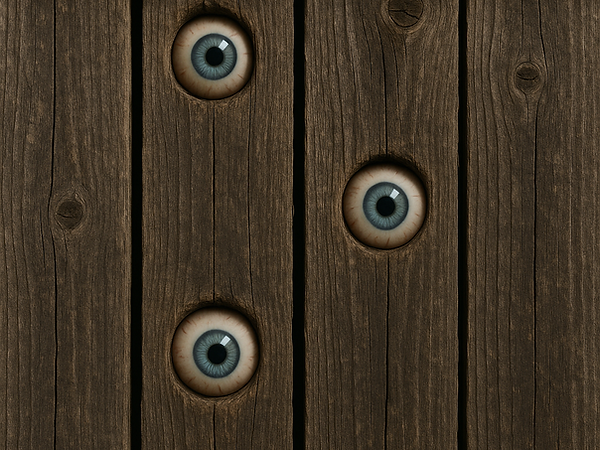
Eyes in the fence. That’s how it begins. At first, Lila mistakes them for garden spray, soil kicked up by the dog, but on second glance, pupils one-two, ringed polar blue, with the sclerae halfway melted into the white-picket PVC. No lid. No lash. They flinch side to side until they notice her, saccades strung into a clean line, and dilate when she comes to a stop.
Lila blinks. The eyes in the fence do not.
She hooks her bookbag more firmly over her shoulder and returns to the sidewalk. At thirteen, pre-algebra takes priority over imagined voyeurs. This is the year of braces and knee scrapes and sharing her cucumber melon hand sanitizer with JJ Flanagan in fifth period; the sanitizer was expensive, a consolation purchase in lieu of the training bra she didn't need, but since kindergarten, JJ has been kind to her in a way most boys aren’t. They are always neck and neck for grades. Today she beats him on the pop quiz, and he gives her a high five.
The eyes are still there when she walks home. She changes her route and doesn't think about them again until a pair crops up on her locker. Brown this time. When she points them out to a nearby teacher, he indulges her by looking the locker up and down once, twice. The eyes quiver like Jello.
After a moment, he smiles, his entire face becoming one big crinkle as he pats her between the shoulder blades.
"Looks normal to me," he says.
By junior year, they've multiplied, spreading down the block like a bad rash. Lila owns six bras now: three that fit, the rest nostalgic relics of a pre-SAT-prep era. JJ sits behind her in calc and snaps the nude strap where it's fallen past her sleeve. She tells a friend, who tells a teacher, who switches her seat to the back, so that she's pressed up against the stained, gum-smeary window, and has to squint to see the whiteboard. However many odd turns she takes on the walk home, there are always eyes, a few dozen speckling the fences and doors and curbs. A pair sprouts on the calc window just before midterms. She knows better than to point them out to anyone. She stops leaving the house without a cardigan.
Summer after graduation is spent at the discount grocer, stacking cans and fielding passive- aggressive couponers and rotating the melons on top of the display to hide the worst bruises. The city is sagging under a heat wave, the fifth-in-a-row hottest year on record. She has a drawer full of bras in a candy store array of pastels, and wears them under tube tops too tight to slip. When her parents talk about gap years and other options, she nods just enough to pass as listening.
On her birthday, the big one, she starts awake early with the numb beginnings of a panic attack pricking the back of her neck. The eyes are still there. This, by now, is familiar enough to be comforting, and then she turns her gaze further to find the sidewalk turned tongue meat.
Everywhere, once pavement is now appleskin pink, damp, and pebbled. Papilled. When she steps off the front porch, the ground dimples beneath her weight.
By two or three in the afternoon, the air blurs with the saliva-scented fog that rises, steaming, from the newly rosy earth, tasting of coffee or of vodka, clinging to hair and to polyester and leaving her generally sticky all over. After a week of daily showers and double laundry, she asks
the girl at the next register over, "Is it for a street fair or something?”
"Street fair?”
"The roads. Making them pink.”
Her coworker stares. "What are you talking about?”
She looks out the window. Sees the streets, peach and plush and hungry, and the clustered eyeballs blooming towards each other in patches on every building.
"Are you okay?”
She doesn't respond. In a bid to put more distance between her skin and the ground, she starts wearing her running shoes everywhere, even to belated birthday date night with JJ. This does nothing. One-point-five inches of nitrogen foam aren't enough to mask the red wet undersole throb.
Teeth in the fence is how it ends.
Next to the eyes, in the eyes, beading up ivory in the cracks between lawn and sidewalk, gnawing at her shoes and grinding against each other in perfect counterpoint to the cicada-cricket whine. It's just after midnight when she slips out of the warm navy sheets—quietly, so as not to wake him—and goes at them with pliers. They don't come easy. Desperation makes her sloppy.
The pliers slip into the tongue flesh nearby, sending up a fine cloud of spittle, and clear-diluted scarlet trickles into the grass, which, brown from the heat, thickens to fingers that wrap around her wrists and ankles and pull her down into the soft, thirsty soil.
She kicks. Her voice stiffens, solid in her throat. Rolling over rewards her with a faceful of dirt; she arches, yanking some of the grasping hands up with her, and spits out a wet brown clod when tugged back down. In the end, it is almost a relief to let herself go slack. To splay fingers and drop jaw. To give in to the grass, the teeth, the sidewalk, all grip and nick and lapping at her wherever there is skin for tasting. When she squints open through the muck, she sees there is no fence anymore, not really, just a roiling sea of pupil and iris and finely branching ophthalmic offshoots, and it’s impossible to focus on any one pair, until there, there! Incisors in her thigh.
The pain clarifies, and she uses the brief moment of lucidity to lock onto one particular point. The pale blue halo. The empty black center.
In the near-perfect dark before dawn, the only eyes she can see are her own.
Alaina Anderson is an NYC-based writer, actor, and musician. After receiving a B.A. in Cognitive Science from Yale University in 2022, she began freelancing as a ghostwriter and fiction editor. Offstage and off-page, you can sometimes find her stocking shelves (and giving incredibly specific book recs) at The Ripped Bodice Brooklyn. alainaanderson.com
Only Child by Anna Rosel

When I ask Mum why I don’t have any siblings, she says I’m already enough for her. I don’t feel like enough. I try again, but this time she asks if she isn’t enough for me. I know better than to ask again. Dad just listens from the sofa.
On Christmas Eve, Mum takes me to church. She isn’t religious, but her parents were. That’s all I know about them.
“You should be grateful I’m nothing like them,” she says. “I only make you come here once a year. They made me come every week. Aren’t you glad?”
I nod.
When we get to the church, I like to ask God questions. I ask if I’ll ever get a baby sibling. He doesn’t know, so I ask why I feel empty inside. He says I’m lonely. “Isn’t this horrible?” Mum asks me, speaking over God’s private response. “Isn’t this so boring?”
I nod again, hoping the droning pastor can’t hear. God probably can, but I’m sure he’s used to it.
The drive home is quiet. I wish we weren’t going home. I wish I could talk to God more than once a year.
Mum drops me off at our driveway. She’s going to see her sister tonight, and I guess she doesn’t want me to come.
Inside, Dad is still on the sofa. He doesn’t usually say anything, but I wonder if that’s because Mum’s always talking. I ask him if he can give me a sibling. He doesn’t answer, so I go to my room. It’s not huge, but it could fit a bunk bed just as easily as a twin. It’s so empty in here it hurts.
I go back into the living room and stand beside Dad’s sofa. “How do you make another person?” I ask. He doesn’t answer, so I ask again.
“Cut one in two,” he says. His voice is deeper than I expected, and I can’t tell if he’s joking. He doesn’t say anything else, so I guess it’s the truth.
I take a knife from the kitchen and go back to my room. I don’t know if the two parts have to be equal, so I start somewhere easy. I trace a red line around my ankle. It hurts, but not as much as the emptiness hurts. But my brother doesn’t come off right away. I have to trace the line a few more times and pull hard until he’s in my arms.
“It’s okay,” I tell him. “I’ll take care of you.” But he doesn’t stop crying.
Anna Rosel has spent her life indecisively moving back and forth between BC and Alberta. Currently, she resides in Alberta where she is studying Computer Science, but the magnetic draw of the ocean tells her that she'll move back to the coast one day. Regardless of where she's living, Anna is dreaming up fantastical events about people she almost knows and sometimes even writing about things that might almost have happened in another dimension.
Eating for Two by Chase Olsen

I’ve just finished dinner, and my stomach is already growling. I prepared a box of pasta, topped with an entire jar of pasta sauce and a dozen meatballs, and polished it off with four cheese-filled breadsticks and a two-liter of Sprite. It had taken me four minutes to rinse my dishes and place them in the dishwasher before I realized that I was still fucking hungry.
As I dig through the cabinets for something to eat, I catch a glimpse of myself in the grimy surface of the microwave door. I try not to look at my sunken eyes or patchy hair. I get enough of a look in the bathroom mirror each morning.
I find some tortilla chips in the pantry and tear into them. I pulverize the salt-covered shards with my tongue, closing my eyes and leaning against the kitchen counter. For a few brief seconds, the sensation fades.
It was a month ago that I noticed something was wrong, or rather, everyone else noticed something was wrong. I’d go out with friends and order twice as much food as I normally would. I’d stuff my face and then still want more. At home, I was constantly eating, not just snacking here and there, but eating entire meals that would typically leave me full for hours. First was dinner. And then a second dinner. And then a third dinner. The only time I wasn’t eating was when I’d pass out from exhaustion each night, only to wake up starving in the morning.
The strangest part? I wasn’t gaining any weight. If anything, I was losing it. My ribs were visible whenever I wasn’t wearing a shirt (never, these days), my figure slim, and my muscles nonexistent. I didn’t understand what was happening to me. The internet was unhelpful with its suggestions: Crohn’s disease, cancer, a gland disorder, cancer, internal parasite, depression, cancer.
“Maybe you should see a doctor,” a friend had suggested after watching me demolish a rack of ribs and then order two slices of cake for dessert. In this economy? With all the food I’m buying, I can hardly afford to throw money at someone who’s just going to tell me I’m lacking in willpower. All this eating, and I never seemed to have any energy. Like my body wasn’t even metabolizing the vast amount of food that went down my throat.
In the bathroom, I try not to look at myself in the mirror as I turn on the bathtub’s faucet. Avoiding reflective surfaces keeps me from having to deal with a problem I don’t know how to deal with. The TV in the living room is covered with a sheet so that I don’t have to see
myself when it’s not on. My phone stays face down unless I need to use it to order food. People stopped calling and texting a while ago.
During one of my internet searches, I learned about these worms that can only be found inside crickets. I don’t really know how they get inside the crickets, but that’s where they live. The worms do something to the crickets’ brains that makes them really thirsty, so thirsty that the crickets will drown themselves as soon as they find a body of water. The worm waits for the cricket to die before it enters the water, where it can complete the rest of its life cycle, and somewhere along the way, its babies end up in more crickets.
Is that what I have inside of me? Some sort of brain worm that’s making me seek out food until I die? Nothing seems to help. No quantity of food does the trick. I eat and I eat until I can’t even breathe. Sometimes I throw it all up. Either way, I’m still hungry after.
I slip into the tub, my stomach bulging from my Italian dinner and tortilla chip afterthought, and yet all I feel is the familiar hollowness returning. The warm water does little to combat the pain. It doesn’t matter what I eat. Sweets, carbs, veggies, I even ate a raw steak once, and all I got was a twenty-four-hour stomach bug that kept me in bed until I was too starved to sleep. I ended up crawling from my room to the kitchen, eating whatever I could reach in the bottom drawer of my refrigerator.
My hand rubs over my stomach in a vain attempt to relieve some of the pressure I feel. I’m still hungry. I lift my hand to inspect it, wincing at the tightly drawn skin and the boniness of the digit. I slip my index finger into my mouth, running my tongue over my nail and knuckle. I grip the side of the bathtub tightly and bite down. I’m surprised at how easily my teeth cut through my flesh and bone, or I would be surprised if I weren’t too busy savoring the crunch and the warmth that fills my mouth. For a few brief seconds, I’m not hungry anymore.
Chase Olsen is an author living in central Iowa. His writing is often informed by his live growing up as a gay man in the Midwestern United States. He seeks to write from these experiences, combining them with the natural (and sometimes unnatural) world. He has had pieces published in Querencia Press and Assignment Literary Magazine. He has even had a piece performed by the Delta Literary Arts Society.
I Know You Can Hear Me Even When You're Sleeping by Boyd Blackwood

So, listen, Cody, and pay attention.
People call me your imaginary friend. A phase. Something you’ll 'grow out of,’ the therapist said.
You and I both know better. We’ve been connected since that night you cried in the closet, remember? When you asked if someone could stay with you forever?
I said yes.
So, I have a little proposal, Best Friend.
That bully who takes your lunch money, he’s not going to stop.
And the new baby–always screaming, always stinking up the place–she’s about to rob you of all the family’s love and care.
We both know you’re not strong enough to do what needs to be done.
I overheard your father threatening to send you back to another mind doctor.
They don’t think I exist, Cody.
But they still want to get rid of me.
I wouldn’t like that.
You wouldn’t like that.
Let me fix things for us.
Don’t pull away.
Listen, Cody...
Let me use your body for a while.
Boyd Blackwood has earned a living as a writer through a long career in advertising and marketing. (He created the names for, and helped launch the national AmeriCorps program and Staffmark, the nationwide employment agency.) Today, his passion is for writing dark fiction with a twist. He has recently published stories in “Flash Fiction Magazine,” “DarkWinter,” “The Yard: Crime Blog,” “Roi Fainéant,” and the forthcoming anthology, “Tales from the Unknown.”
Silencing Desire by Tinamarie Cox

There was too much tangy liquid in her mouth to swallow. Blood bubbled up and sputtered between her lips and streamed down the sides of her face. Her delicate jaw trembled as thick crimson lines were painted across her pale skin. She could no longer hear the thump of her heart, but the blood continued to exit in a steady pulse from her wounds.
Her limbs tingled with cold, a numbing sensation rendering her motionless. She was his completely. The impulse of fight or flight had evaporated. The fear she felt moments earlier spilled from her body with her blood. She stared blankly at the man made of shadow hovering over her, no questions left in her eyes.
“It is a screeching desire,” he explained with a smooth thumb gliding across her red chin. “I try to hide it, keep it muted and bound. But I feel it struggling against my binding, wriggling and moaning in my darkness. This truly isn’t something personal, my darling. I need to satiate the monster and set myself free. Escape the screaming.”
He plunged the knife into her soaked abdomen one last time. There was no longer any resistance to her battered, leaking flesh. Her body accepted the blade and her fate. No sounds escaped with the blood from her open mouth.
“Finally, it’s quiet again,” he said in tune with her last breath. He closed his eyes and smiled with his deep sigh, and they both were bathed in the silence.
Tinamarie Cox lives in Arizona with her husband, two children, and rescue felines. Her written and visual work has appeared in a number of publications under various genres. You'll find her more unsettling works in As Alive Journal, Haunted MTL, Blood Moon Rising, and others. Follow her on Instagram @tinamariethinkstoomuch, and find more of her work at: tinamariethinkstoomuch.weebly.com